Norms Impact
Pam Bondi Flatters Trump With Claim That 75% of America Would Be Dead If Not for Him
The attorney general used the Justice Department’s fentanyl seizures as on-camera praise for the president, blurring the norm that federal law enforcement answers to law, not personal loyalty.
Apr 30, 2025
⚖ Legal Exposure
Sources
Summary
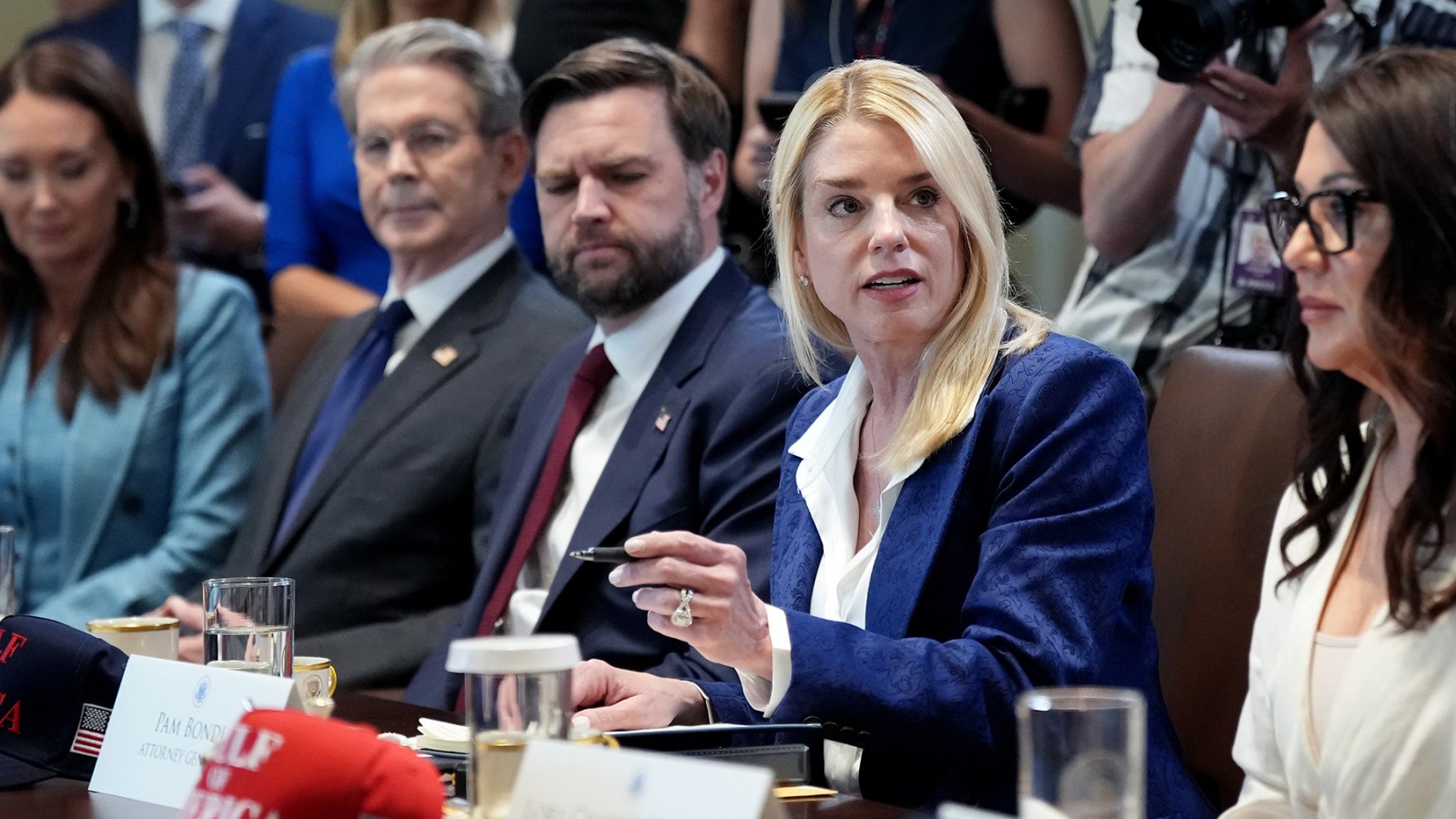
At a White House Cabinet meeting, Attorney General Pam Bondi told President Donald Trump that fentanyl seizures since he took office “saved” 258 million lives and credited him with preventing mass death nationwide.
The nation’s top law-enforcement official publicly positioned the Justice Department’s work as personal tribute to the president, framing enforcement outcomes as evidence of his singular leadership.
This messaging collapses prosecutorial independence into presidential loyalty and signals that federal law enforcement is expected to validate political narratives on camera.
Reality Check
When the attorney general turns enforcement metrics into personal tribute to the president on national television, we normalize a Justice Department that performs for political loyalty rather than independent application of the law—an erosion that ultimately weakens our own protections against selective prosecution. The conduct described is not clearly a stand-alone federal crime on these facts, but it squarely violates the core governance norm against politicizing prosecutorial power and treating federal law enforcement as a presidential branding arm. The legal risk is downstream: once DOJ leadership frames outcomes as owed “because of you,” it invites pressure on charging decisions and investigations that can slide toward abuse-of-office patterns and corrupt intent—precisely the terrain where federal obstruction and public-corruption statutes can come into play when paired with specific acts.
Legal Summary
The article describes hyperbolic, loyalty-forward public statements by the Attorney General in an official setting that raise appearance-of-impartiality and political-use-of-office concerns. It does not describe any financial transfer, quid pro quo, or official act exchanged for value, so exposure is best characterized as an ethics/appearance issue rather than prosecutable structural corruption on the stated facts.
Legal Analysis
<h3>5 C.F.R. § 2635.101(b) — Executive Branch ethics principles (appearance of losing impartiality)</h3><ul><li>As described, the Attorney General uses official settings (Cabinet meetings; media-facing remarks) to lavish exaggerated praise on the President and frames DOJ actions as being done “because of you,” which can create an appearance that prosecutorial/enforcement priorities are driven by personal loyalty rather than neutral law-enforcement criteria.</li><li>The article characterizes her conduct as acting like a “campaign spokesperson,” raising ethics/appearance concerns about impartial administration of justice, even without a specific identified case or target.</li></ul><h3>5 C.F.R. § 2635.702 — Use of public office for private gain (general ethical constraint)</h3><ul><li>Publicly crediting the President personally for law-enforcement outcomes in a highly performative setting risks using official communications to advance a political/personal benefit narrative; however, the article does not allege solicitation of value, fundraising, or concrete private benefit tied to the statements.</li></ul><h3>18 U.S.C. § 201 — Bribery/gratuities (not supported on stated facts)</h3><ul><li>No allegation of any payment, thing of value, or third-party benefit exchanged for an “official act,” so the structural money-access-official-action alignment necessary for prosecutable bribery is absent in the described conduct.</li></ul><b>Conclusion:</b> The conduct described reflects an ethics and impartiality-appearance problem (political/personal loyalty signaling by the Attorney General) rather than a transactional, money-for-official-action corruption pattern or a clearly chargeable federal crime on these facts.
Media
Detail
<p>President Donald Trump held a Cabinet meeting at the White House on Wednesday, one day after marking his first 100 days in office. Multiple Cabinet officials offered personal praise of Trump’s performance during the meeting.</p><p>Attorney General Pam Bondi, seated across from Trump, told him his first 100 days “far exceeded” any other presidency. Bondi then cited that the administration had seized 3,400 kilograms of fentanyl since Trump took office and stated this “saved” 258 million lives, addressing the media on camera and attributing the result to Trump’s actions.</p><p>Bondi also claimed “kids are dying every day” from drugs “laced” with fentanyl and suggested youth are seeking common medications on the black market, characterizing the situation as “no longer” occurring “because of” Trump.</p>