Norms Impact
‘Alligator Alcatraz’ immigrant detention facility opens, with Trump in attendance
A state used emergency powers to seize county land and erect a mass detention camp in eight days, and the president endorsed exporting the model—treating hardship as policy, not a safeguard.
Jul 2, 2025
⚖ Legal Exposure
Sources
Summary
President Donald Trump attended the opening of a Florida-run immigrant detention facility in Ochopee built in eight days using emergency powers and designed to hold 500 detainees with plans to expand to 3,000.
Florida’s executive branch, led by Gov. Ron DeSantis and Attorney General James Uthmeier, used emergency authority to fast-track a $450 million-per-year detention complex and seized county land over local objections, with federal approval required for state operation.
The project normalizes rapid, politically branded detention expansion and land seizure while turning harsh conditions into an explicit deterrence tool for immigration enforcement.
Reality Check
Building a detention complex by emergency decree, on seized county land, while openly touting harsh conditions as a deterrent sets a precedent where executive power becomes a shortcut around accountability, and our rights shrink with every “expedited” exception. On these facts alone, criminality is not established, but the conduct squarely raises core rule-of-law failures: using emergency authority to bypass normal procurement, oversight, and local consent while turning confinement conditions into a political tool. If any part involved corrupt contracting, misuse of federal funds, or falsified procurement records, the exposure could run through federal fraud and corruption statutes such as 18 U.S.C. § 1343 (wire fraud), § 666 (theft/bribery concerning programs receiving federal funds), and § 1001 (false statements), but the record here primarily shows a governance breakdown, not a proven charge. The durable damage is the normalization of “detention by spectacle,” where public administration is reorganized to reward cruelty, speed, and political branding over transparent, lawful process.
Legal Summary
The article presents investigative red flags around expedited emergency action, rapid procurement/vendor hiring, and political monetization (fundraising/merchandise) connected to an official project. However, it does not allege a specific financial transfer to an official (or their proxy) tied to an official act, so prosecutable bribery/extortion exposure is not established on these facts alone. Further investigation would focus on procurement communications, contractor/donor links, and any misuse of public resources for partisan fundraising.
Legal Analysis
<h3>18 U.S.C. § 201 — Bribery of public officials / illegal gratuities</h3><ul><li>ARTICLE CONTEXT describes political benefits ("boost in campaign contributions" and merchandise sales) alongside rapid facility approval and construction, but does not allege any thing-of-value was provided to an identified federal/state official in exchange for a specific official act.</li><li>Absent a payer/recipient linkage and a concrete quid-pro-quo structure, the current facts support scrutiny but do not yet satisfy bribery/gratuity elements.</li></ul><h3>18 U.S.C. § 1951 — Hobbs Act extortion (under color of official right)</h3><ul><li>The article alleges use of emergency powers, expedited vendor hiring, and land seizure over local objections, but does not allege officials obtained property/payments from vendors or others induced by official power.</li><li>Key gap: no identified coerced transfer of money/property to an official (or their designee).</li></ul><h3>52 U.S.C. § 30114 / 11 C.F.R. Part 113 — Misuse of campaign funds / conversion (campaign-finance compliance)</h3><ul><li>The article notes a political fundraising and merchandise-sales surge tied to the facility’s national attention; if any state resources, official facilities, or government contractors were used to facilitate partisan fundraising/merch operations, that could raise campaign-finance or ethics issues.</li><li>Key gap: no allegation that government funds/resources were used for campaign purposes or that proceeds were converted for personal use.</li></ul><h3>5 C.F.R. Part 2635 / state ethics analogs — Misuse of public office for private gain (ethics)</h3><ul><li>Using harsh conditions as a stated “deterrent” and leveraging the project for political gain, plus emergency-procurement acceleration and land seizure, raises ethics/propriety concerns and warrants document review (procurement justifications, vendor selection, communications).</li><li>However, the article does not allege personal enrichment or a transactional exchange between donors/vendors and official action.</li></ul><b>Conclusion:</b> The facts as stated reflect significant procedural/political irregularity risk (emergency powers, expedited procurement, land seizure) and potential ethics/campaign-use concerns, but they do not yet show a money-to-official-action quid pro quo sufficient to charge structural public-corruption offenses without further evidence.
Media
Detail
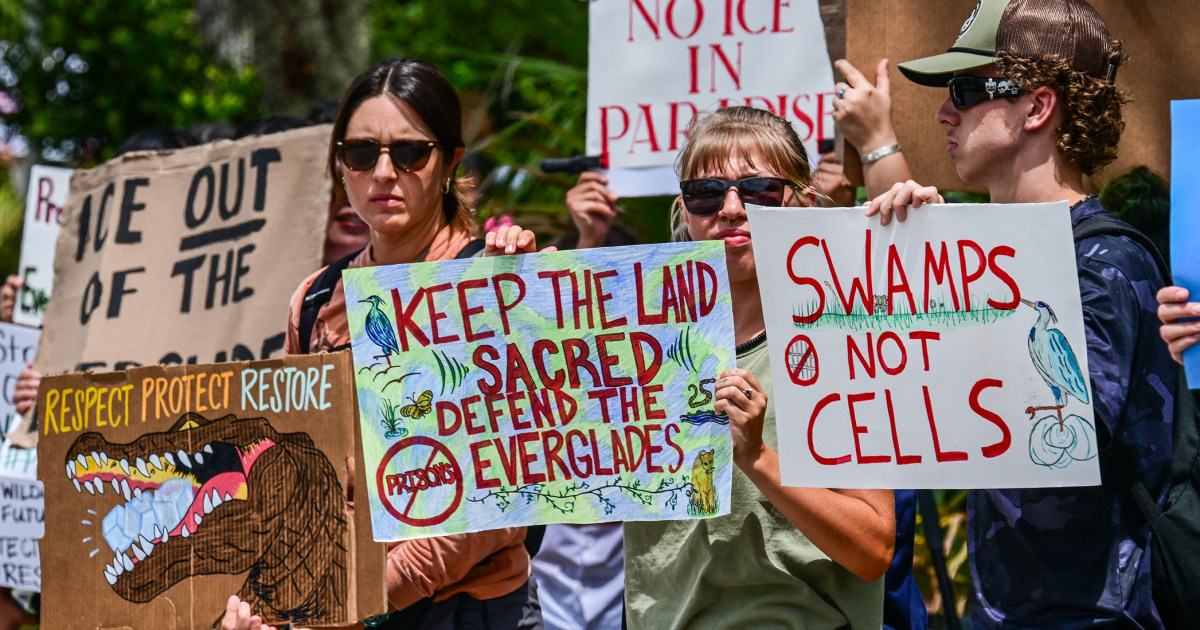
<p>President Donald Trump and Homeland Security Secretary Kristi Noem joined Florida Gov. Ron DeSantis and other state leaders in Ochopee, Florida, on Tuesday for the opening of a new immigrant detention center in the Everglades region, informally called “Alligator Alcatraz” by state Republicans.</p><p>Florida Attorney General James Uthmeier originated the plan. DeSantis’ administration used emergency powers to expedite the facility, constructed the compound in eight days, hired multiple vendors, and seized land from Miami-Dade County over local leaders’ objections. The site is on a little-used airstrip with a runway DeSantis said could be used to fly undocumented immigrants to third countries if deportation is deemed appropriate.</p><p>During a tour, acting ICE Director Todd Lyons said the facility currently holds 500 detainees and will be expanded to as many as 3,000. Lyons said ICE plans to hold detainees at the site no longer than 14 days and that it can withstand winds up to 120 mph.</p><p>Environmental groups filed a federal lawsuit Friday. Roughly 100 protesters were present Tuesday.</p>