Norms Impact
White House propaganda video shows SWAT team swarming D.C. home of DOJ employee charged for throwing sandwich
A White House-branded SWAT re-arrest video turns federal law enforcement into political theater, eroding the norm that prosecutions are not staged as government propaganda.
Aug 15, 2025
⚖ Legal Exposure
Sources
Summary
The White House released a professionally edited, multi-camera video depicting a SWAT-style nighttime re-arrest of Sean Charles Dunn, a former Justice Department employee charged federally after allegedly throwing a wrapped Subway sandwich at a federal officer. The administration paired a highly militarized spectacle with an extraordinary assertion of federal control over Washington, D.C.’s policing apparatus. The result is a public-facing model of enforcement that normalizes escalated tactics and messaging power at the expense of due process expectations for ordinary residents.
Reality Check
Weaponizing a second, militarized arrest for cinematic White House distribution sets a precedent where the executive branch uses policing as messaging, chilling dissent and weakening your basic expectation of fair process. The underlying charge—“forcibly assaulting, resisting, or impeding” a federal officer—tracks 18 U.S.C. § 111, but nothing here justifies converting routine surrender mechanics into a propaganda-ready raid. If agents blocked access to counsel during custodial processing, that conduct raises acute constitutional and ethical concerns even where the Sixth Amendment’s attachment line is contested. The deeper breach is governance: a federal power surge in D.C. paired with staged intimidation normalizes enforcement by spectacle rather than necessity.
Legal Summary
The described conduct presents serious investigative red flags: a heavily produced White House “propaganda” raid video and a SWAT-style re-arrest of a non-fleeing suspect who had previously been apprehended and released, plus an allegation he was not allowed to call counsel. On the stated facts, the strongest exposure is potential civil-rights and ethics/abuse-of-power scrutiny rather than a fully charge-ready corruption case, with key gaps around willfulness and specific constitutional deprivation.
Legal Analysis
<h3>18 U.S.C. § 242 — Deprivation of rights under color of law</h3><ul><li>Article alleges a “SWAT-style” re-arrest of a non-fleeing suspect who, according to court records, had already been apprehended and released days earlier; if force, detention conditions, or denial of counsel were willfully excessive, this raises civil-rights exposure.</li><li>Dunn’s counsel asserts officers did not allow him to call his attorney during the second arrest; if true and tied to custodial interrogation or access-to-counsel restrictions, it is a potential constitutional-violation fact pattern, though willfulness and specific right impairment are not established in the article.</li></ul>
<h3>18 U.S.C. § 241 — Conspiracy against rights</h3><ul><li>The coordinated multi-agency operation (police, FBI, U.S. Marshals) could be scrutinized for coordinated intent to intimidate or unlawfully punish; the article provides no direct evidence of an agreement to violate rights, so elements are presently incomplete.</li></ul>
<h3>5 C.F.R. § 2635 (Standards of Ethical Conduct) / Hatch Act principles (political activity constraints) — Government resources used for political/propaganda purposes</h3><ul><li>The White House released a “professionally edited, multi-camera” raid video branded “The White House. President Donald J. Trump,” suggesting use of official imagery/operations for messaging; this is a classic ethics/administrative-law concern absent clearer statutory misuse-of-funds facts.</li><li>The framing (“Operation Make D.C. Safe Again Edition”) and cinematic presentation may indicate politicized law-enforcement messaging; the article does not establish a specific unlawful expenditure or directive tied to an election, limiting criminal exposure.</li></ul>
<h3>18 U.S.C. § 1505 / § 1512 — Obstruction-related theories (witness/party interference)</h3><ul><li>The article implies the government bypassed voluntary surrender efforts and used overwhelming force; without facts showing intent to impede a proceeding, tamper with testimony, or corruptly influence outcomes, obstruction elements are not met on this record.</li></ul>
<b>Conclusion:</b> The article describes a significant politicization/irregular-procedure risk (propaganda-style federal raid, alleged denial of attorney contact), but it does not provide facts showing a money-to-power quid pro quo or a clearly prosecutable corruption transaction; the exposure is primarily investigative civil-rights/ethics in nature pending development of willfulness and specific rights violations.
Media
Detail
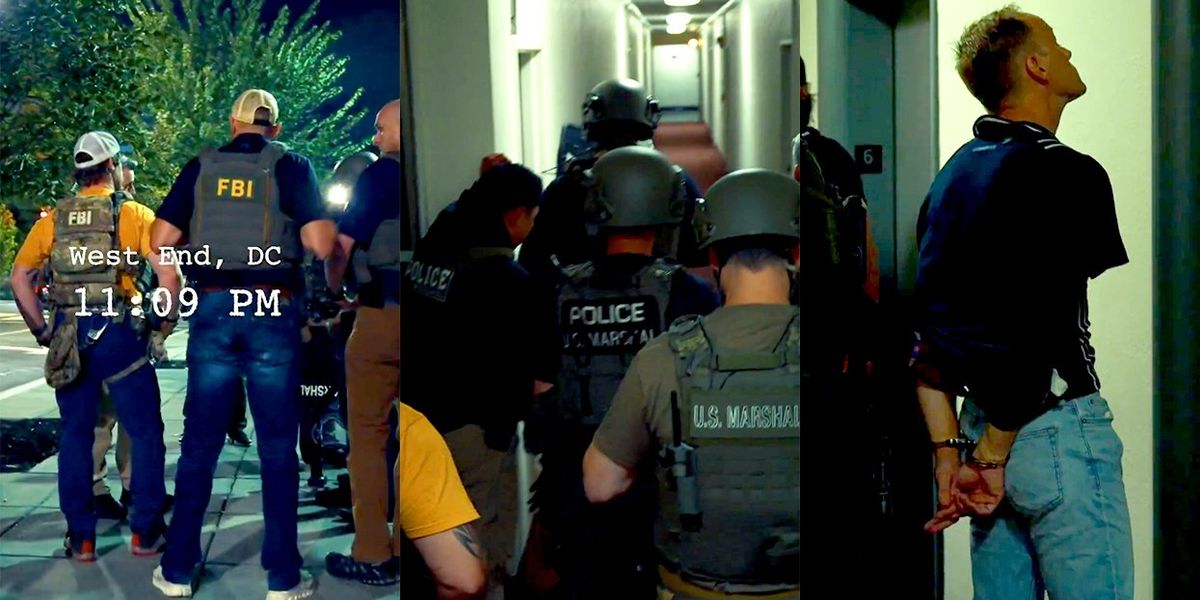
<p>On Thursday, the White House posted a produced video titled “Nighttime Routine: Operation Make D.C. Safe Again Edition” showing police cars, FBI agents, and U.S. Marshals converging on a West End apartment building in Washington, D.C., and officers entering an apartment corridor with guns drawn and shields before escorting a handcuffed man to a police vehicle.</p><p>The target was Sean Charles Dunn, 37, a former Justice Department international affairs specialist. He was charged with felony assault for allegedly throwing a wrapped Subway sandwich at a U.S. Customs and Border Protection officer during a late-night federal deployment in D.C.’s U Street corridor on Sunday. Court records indicate Dunn was apprehended shortly after the incident, processed at D.C. Superior Court, and released without charges.</p><p>Prosecutors later obtained a federal warrant on Wednesday charging him with forcibly assaulting, resisting, or impeding a federal officer. In court Thursday, Dunn’s attorney said she was arranging a voluntary surrender when officers instead went to his home and he was not allowed to contact her.</p>