Norms Impact
Bannon Tells GOP: ‘Seize the Institutions’ of Government Now or We’re ‘Going to Prison’ After 2028 | Common Dreams
Bannon’s “seize the institutions” directive normalizes using lawmaking, procedural overrides, and federal agencies as partisan weapons to entrench power and punish political opponents.
Nov 7, 2025
⚖ Legal Exposure
Sources
Summary
Steve Bannon urged aspiring conservative staffers on Capitol Hill to “seize the institutions” of government and codify President Donald Trump’s executive orders into law to prevent losing power and facing imprisonment after 2028. The message centers on using institutional control—legislation, procedural rule changes, and pressure on federal agencies—to lock in a maximalist governing program beyond electoral accountability. The practical consequence is an explicit roadmap for politicizing the machinery of state power, including calls to use federal departments to target a named political opponent’s citizenship.
Reality Check
Normalizing the use of DOJ, DHS, and State as tools to strip a named opponent’s citizenship and deport him is a blueprint for state retaliation that can be turned on any of us when power changes hands. If officials acted on this for political retribution rather than lawful grounds, it would implicate federal civil-rights and abuse-of-power statutes, including 18 U.S.C. § 242 (deprivation of rights under color of law) and conspiracy exposure under 18 U.S.C. § 241. Even where prosecutors can’t prove criminal intent beyond a reasonable doubt, the conduct described is a direct assault on anti–quid-pro-quo governance norms and the rule-of-law principle that federal power cannot be wielded to settle elections or silence lawful political participation.
Legal Summary
Bannon’s remarks advocate aggressive institutional takeover to entrench power and explicitly call for federal agencies to target a named political figure’s citizenship, raising serious investigative red flags around potential abuse of government power and retaliatory enforcement. The article does not allege an actual agreement to commit unlawful acts, execution by officials, or a money-access-official-action quid pro quo, so criminal exposure is not yet substantiated but warrants scrutiny.
Legal Analysis
<h3>18 U.S.C. § 371 — Conspiracy to defraud the United States / impair lawful government functions</h3><ul><li>Bannon urges Republicans to “seize the institutions” and “get beyond these structural barriers” to consolidate power and codify executive actions, framing the objective as avoiding future prosecutions (“we’re going to prison” if they lose power), suggesting intent to frustrate normal governmental checks.</li><li>Article describes behind-the-scenes contact with U.S. senators about advancing a “maximalist strategy,” which could be an investigative red flag for coordinated efforts to impair lawful oversight functions, though no agreement, overt act, or specific unlawful means are detailed.</li></ul><h3>18 U.S.C. § 242 — Deprivation of rights under color of law (conceptual exposure via advocated misuse of power)</h3><ul><li>Bannon calls for DOJ/State/DHS to target a named political figure (Zohran Mamdani) by pursuing citizenship revocation and deportation—if executed without lawful predicate and motivated by political retaliation, such conduct could implicate misuse of governmental power affecting due process/equal protection interests.</li><li>However, the article describes advocacy and urging, not actual official action, and provides no facts showing any agency initiated unlawful proceedings.</li></ul><h3>18 U.S.C. § 1512 — Witness tampering / obstruction (limited fit; intimidation/retaliation theory)</h3><ul><li>The “we’re going to prison” framing and push to entrench power to avoid accountability may signal an obstruction-minded motive (avoiding legal jeopardy through institutional control), but the article does not allege interference with any specific proceeding, witness, or evidence.</li></ul><b>Conclusion:</b> The described conduct reads primarily as politicized, institution-capture advocacy and potential retaliatory targeting rhetoric—an investigative red flag for abuse-of-power planning rather than a fully formed, prosecutable money-for-official-act corruption scheme or completed criminal offense on these facts.</p>
Media
Detail
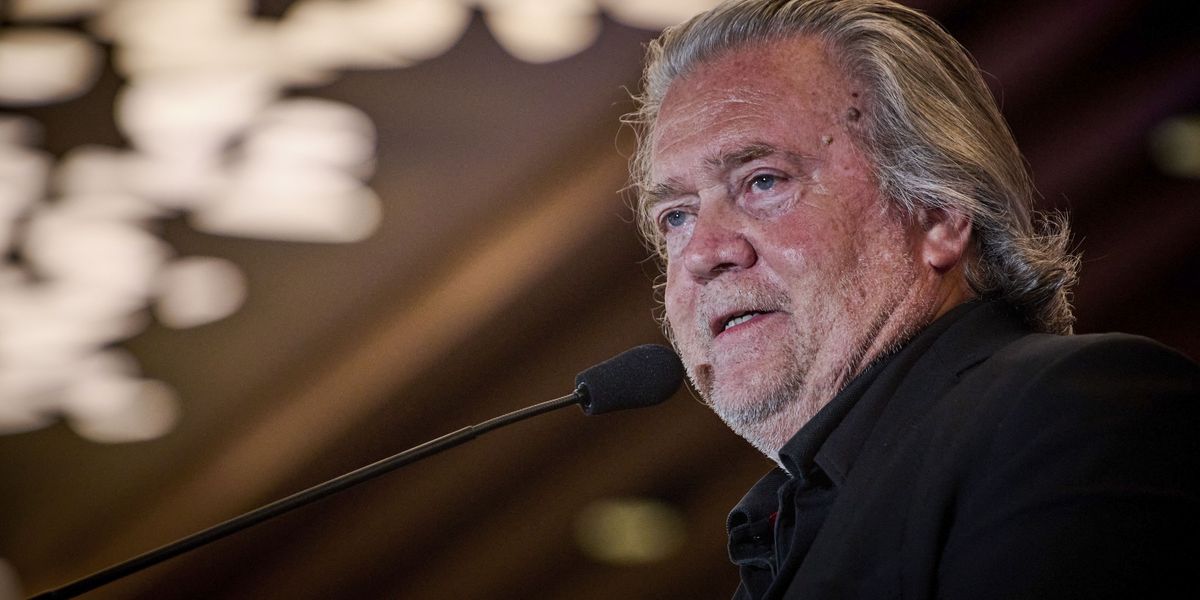
<p>Steve Bannon spoke Wednesday at an awards event on Capitol Hill hosted by the Conservative Partnership Academy, which trains and certifies aspiring right-wing staffers for political and government roles. He told attendees that Republicans should pursue “complete control” of government institutions before next year’s midterm elections and convert as many of President Donald Trump’s executive orders as possible into statute.</p><p>Bannon said that if Republicans lose the midterms and the 2028 election, “some in this room are going to prison,” and he included himself among those at risk. He framed recent Democratic electoral wins in New York City, Virginia, New Jersey, and other contests as a warning that should prompt intensified action. He argued Republicans must “get beyond” what he described as “structural barriers” in Washington, D.C., referencing discussions about major procedural changes in the U.S. Senate.</p><p>Bannon also said he has communicated with Senate Republicans, naming Sens. Josh Hawley and Lindsey Graham, and predicted additional “institutionalists” would soon support his approach. In a separate interview after the elections, he called for the Justice Department, State Department, and Department of Homeland Security to target New York City mayor-elect Zohran Mamdani by pursuing his citizenship and deportation.</p>