Norms Impact
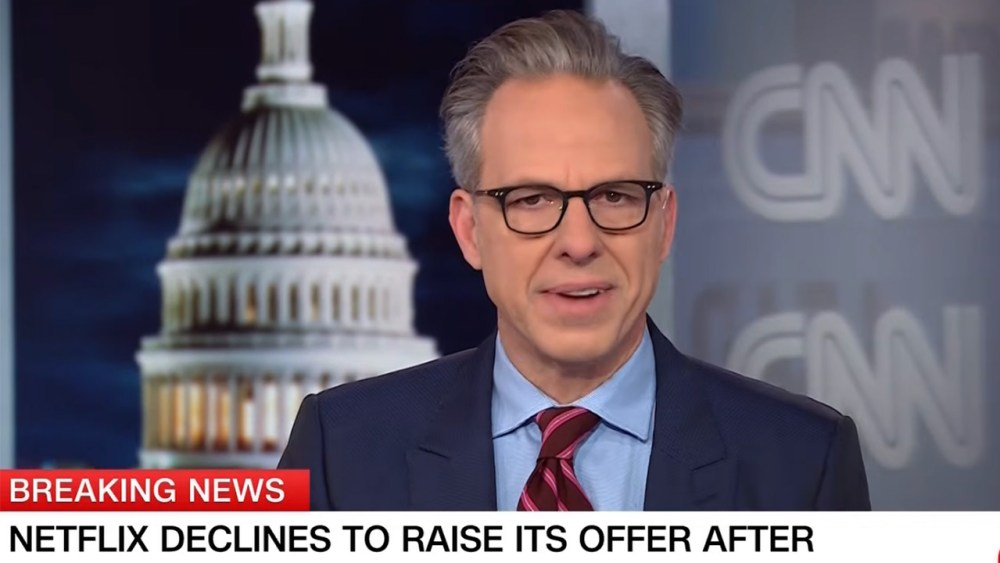
CNN’s Jake Tapper Breaks News of Paramount Buying Network’s Parent Company WBD Live on Air: ‘It Affects Everybody I’m Looking at Right Now in the Studio’
A president’s demand that a major news network be sold collides with a pending acquisition where White House signaling is cited as shaping which bidder wins control.
Feb 27, 2026
⚖ Legal Exposure
Sources
Summary
Paramount Skydance moved into position to become the presumptive new owner of Warner Bros. Discovery, the parent company of CNN, after Netflix declined to raise its bid and WBD’s board deemed Paramount’s offer superior. The prospective transfer of control over a major news network is unfolding amid reported White House access by competing executives and presidential statements urging the network’s sale. The result is an acquisition process where regulatory signaling and political pressure are presented as factors shaping which bidder prevails and what changes may follow at CNN.
Reality Check
This kind of White House–adjacent pressure over who gets to own and reshape a major newsroom sets a precedent that can chill coverage, warp markets, and ultimately weaken your ability to receive independent information. If executive-branch officials are signaling regulatory punishment or relief to steer a private merger toward a politically preferred buyer, that veers toward corruption-risk conduct implicating federal bribery and honest-services theories (18 U.S.C. §§ 201, 1346) even if proof of an explicit quid pro quo is hard. Even without a chargeable case, a president publicly declaring it “imperative” that CNN be sold while a favored suitor promises “sweeping changes” is a textbook assault on anti–weaponization norms: government power and access must not be used to discipline disfavored press institutions.
Legal Summary
The article suggests possible White House signaling and political pressure affecting regulatory outcomes for a major media acquisition, raising substantial concerns about improper influence. But it does not allege a payment, personal enrichment, or an explicit/implicit exchange tying regulatory action to a thing of value. On these facts, exposure is best characterized as an investigative red flag rather than a clearly chargeable corruption scheme.
Legal Analysis
<h3>18 U.S.C. § 201 (Bribery of public officials and witnesses)</h3><ul><li>The article describes repeated White House access by a bidder (Paramount CEO) and statements about making “sweeping changes” if CNN is acquired, while the President states it is “imperative” CNN be sold—creating an appearance of leveraging regulatory power for desired media outcomes.</li><li>However, the article does not allege any thing-of-value transferred to any public official, nor a concrete agreement exchanging an “official act” (e.g., regulatory approval) for a specific benefit; key quid elements are not stated.</li></ul><h3>18 U.S.C. § 1346 & § 1343 (Honest services wire fraud; wire fraud)</h3><ul><li>Stelter’s comment suggests potential signaling from the White House about regulatory “roadblocks,” implying possible politicized use of federal process affecting a major transaction.</li><li>No alleged bribe/kickback scheme is described; without a personal enrichment component or corrupt payment, the core honest-services theory is not established on these facts.</li></ul><h3>5 C.F.R. Part 2635 (Standards of Ethical Conduct for Executive Branch Employees) / Executive-branch ethics norms</h3><ul><li>Allegations of White House “signals” and a President’s expressed desire that a particular media outlet be sold raise concerns of improper political influence over regulatory decision-making.</li><li>On the article’s facts, this reads more as politicization/appearance issues than a transactional corruption scheme.</li></ul><b>Conclusion:</b> The described conduct presents a serious investigative red flag for politicized regulatory influence and potential pressure on a media transaction, but the article does not provide a money-to-official-action transfer or other elements sufficient to treat it as prosecutable structural bribery on its face.
Media
Detail
<p>On Thursday during CNN’s “The Lead,” anchor Jake Tapper returned from a commercial break with a “Breaking News” banner and told viewers that Paramount Skydance had, moments earlier, moved into position to become the presumptive new owner of Warner Bros. Discovery, CNN’s parent company.</p><p>Tapper said Netflix had announced it would not raise its offer to purchase Warner Bros. Studios and HBO after the Warner Bros. Discovery board determined that Paramount had submitted a “superior offer.” Tapper noted that Paramount’s bid encompassed Warner Bros. Discovery as a whole, including CNN.</p><p>Netflix later said it would not match Paramount’s increased bid of $111 million, clearing a path for Paramount Skydance to acquire the company pending regulatory approval.</p><p>On air, CNN media analyst Brian Stelter said Ted Sarandos met at the White House that day and suggested Netflix may have received signals that regulatory roadblocks would be too severe for a Netflix deal. The report also states Paramount CEO David Ellison has frequently visited the White House and that Trump said it is “imperative that CNN be sold,” while Ellison allegedly told the Trump administration he would make “sweeping changes” if CNN were acquired.</p>