Norms Impact
Hegseth Makes Shocking Admission on How Iran Strikes Are Operating
A Defense Secretary publicly discarding rules of engagement and international restraints normalizes war-by-authority, not war-by-law.
Mar 2, 2026
⚖ Legal Exposure
Sources
Summary
Secretary of Defense Pete Hegseth said the United States is conducting an airpower campaign against Iran “on our terms,” with “maximum authorities,” and “no stupid rules of engagement.” The comments signal a Defense Department posture that treats international constraints and traditional targeting guardrails as optional. The practical consequence is a lowered threshold for the use of force and an increased risk of unlawful targeting, civilian harm, and escalation without credible limits or accountability.
Reality Check
Normalizing “maximum authorities” with “no” rules of engagement shifts the use of force away from law-governed restraint and toward executive discretion that is difficult to audit and harder to stop. When senior leaders frame international constraints as optional, we weaken the guardrails that protect civilians, discipline targeting decisions, and preserve accountability inside the chain of command.
This precedent conditions the public to accept warfare conducted through broadened authorities and vague “classified effects,” reducing meaningful oversight and raising the risk of unlawful strikes and escalation. Over time, that erosion turns compliance with restraint into a political choice rather than a democratic obligation—leaving our institutions less capable of preventing abuse in future conflicts.
Legal Summary
Level 2 exposure: the Secretary’s statements indicate potential disregard for rules of engagement and legal restraints, warranting investigation into whether unlawful orders or targeting practices are being encouraged. The article does not allege specific unlawful strikes or directives sufficient to satisfy criminal elements, so the current posture is an investigative red flag rather than a charge-ready structural corruption or war-crime case.
Legal Analysis
<h3>18 U.S.C. § 2441 — War crimes (U.S. jurisdiction over grave breaches)</h3><ul><li>Publicly disparaging “rules of engagement” and praising unconstrained use of force suggests a permissive posture toward operations that could cause unlawful civilian harm, but the article does not allege specific unlawful strikes, targets, or intent.</li><li>Criminal exposure would depend on evidence that U.S. forces committed enumerated grave breaches (e.g., willful killing of protected persons) and that the Secretary ordered, enabled, or willfully disregarded such conduct; those elements are not established in the text.</li></ul><h3>Uniform Code of Military Justice (e.g., 10 U.S.C. §§ 892, 918, 934) — Disobeying lawful regulations; unlawful killings; general article</h3><ul><li>Statements like “No stupid rules of engagement” and “maximum authorities” could indicate pressure for operations outside established ROE or lawful constraints, raising investigative concern about command influence and compliance culture.</li><li>However, the article provides no concrete instance of an unlawful order, a specific violation by subordinates, or resulting casualties attributable to a directive.</li></ul><h3>18 U.S.C. § 371 — Conspiracy (to commit an offense against the United States)</h3><ul><li>The rhetoric could be read as encouraging disregard for legal restraints, but conspiracy requires an agreement and an overt act toward a specific underlying offense; the article supplies neither.</li></ul><b>Conclusion:</b> The article presents serious investigative red flags about adherence to lawful constraints on the use of force and potential facilitation of unlawful targeting, but it does not provide the specific operational facts needed to charge prosecutable war-crimes-related offenses; this is primarily a procedural/legal-compliance exposure absent concrete alleged acts.
Media
Detail
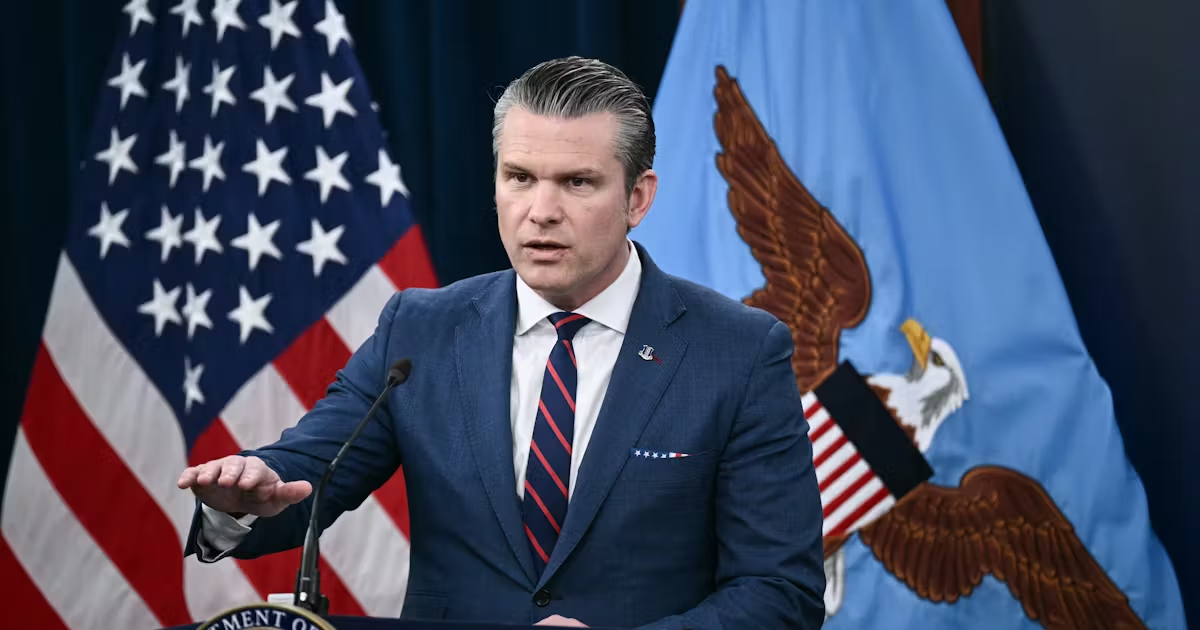
<p>At a Monday press conference, Secretary of Defense Pete Hegseth described ongoing U.S. strikes involving “B-2s, fighters, drones, missiles, and, of course, classified effects.” He said the campaign is being carried out “on our terms, with maximum authorities,” and stated there are “no stupid rules of engagement.”</p><p>Hegseth also praised Israel as a “capable” partner with “clear missions,” while criticizing “traditional allies” who, in his words, “wring their hands” about the use of force. He framed international institutions and international law as nonbinding by asserting action would proceed “regardless of what so-called international institutions say.”</p><p>In the same remarks, he rejected “nation-building,” “democracy-building,” and “politically correct wars,” stating, “We fight to win.”</p>