Norms Impact
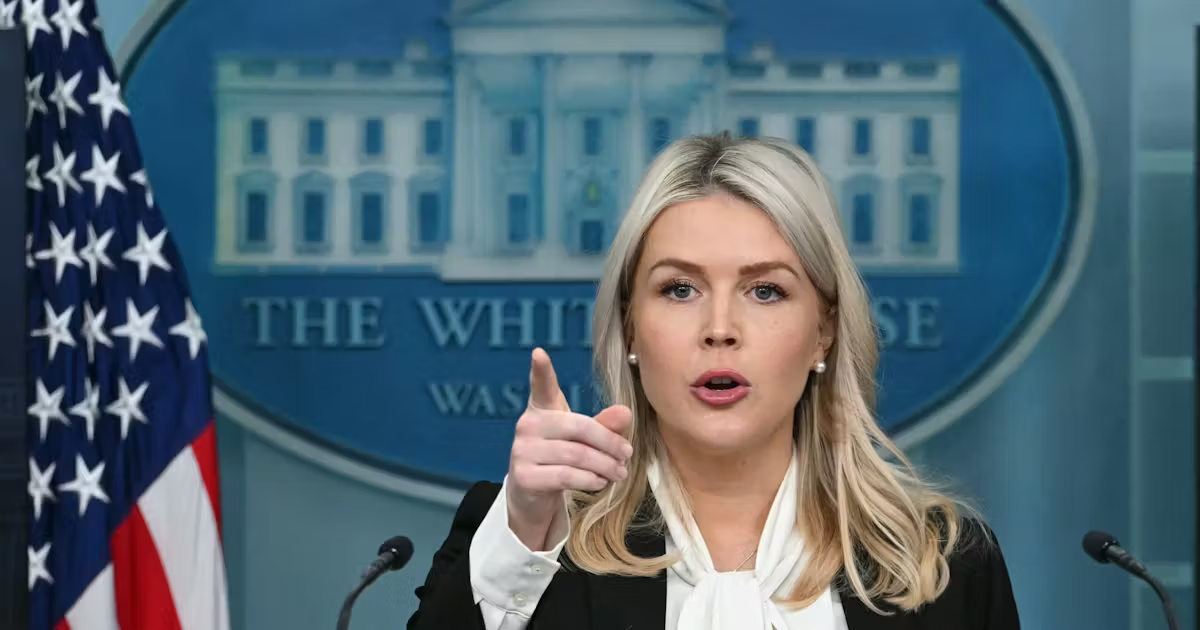
Leavitt Erupts When Asked if U.S. Bombed Girls’ School in Iran
The White House met mass-death reporting with a non-answer, an “investigation,” and attacks on the press—weakening democratic oversight of war by substituting messaging for accountability.
Mar 4, 2026
⚖ Legal Exposure
Sources
Summary
Karoline Leavitt said the U.S. did not know whether it bombed the Shajareh Tayyebeh girls’ school in Minab, Iran, amid reports the strike killed up to 168 people, mostly children. The executive branch publicly paired an asserted investigation with categorical claims about U.S. targeting and accusations that reporters had fallen for Iranian propaganda. The result is a accountability gap in which lethal military action can proceed while responsibility is obscured in real time through official messaging rather than verified facts.
Reality Check
When the executive branch can wage lethal force abroad while withholding clear responsibility and discrediting scrutiny, our war-power guardrails collapse into public-relations management. Normalizing “we don’t know” alongside categorical assurances conditions the public to accept civilian deaths without transparent attribution, verified facts, or accountable decision chains. Over time, this practice erodes democratic oversight of military action by making truth contingent on internal review rather than public, checkable governance.
Legal Summary
The reported incident raises a serious investigative red flag: a documented strike on a girls’ school with high civilian casualties alongside equivocal official messaging and an asserted investigation. However, the article does not allege personal enrichment, transactional quid-pro-quo conduct, or specific decision-maker facts sufficient to support a likely criminal public-corruption charge on these allegations alone.
Legal Analysis
<h3>18 U.S.C. § 1001 — False statements to the federal government</h3><ul><li>The article describes a press spokesperson stating “not that we know of” and that an investigation is ongoing, while also asserting broadly that the U.S. “does not target civilians.”</li><li>On these facts, there is no allegation of a knowingly false statement made to a federal agency in a matter within federal jurisdiction; this appears to be a public-facing, qualified response rather than a demonstrably false factual claim.</li></ul><h3>War crimes / targeting civilians — International humanitarian law (as characterized in article)</h3><ul><li>The article reports an airstrike on a girls’ school with significant civilian deaths and notes that “unintentionally killing civilians can still be a war crime,” but it does not allege a specific U.S. decision-maker, intent, command responsibility, or a concrete U.S. operational link beyond “amid the U.S.-Israeli bombing campaign.”</li><li>Absent alleged facts tying U.S. officials to the strike (order, authorization, knowledge, or reckless disregard), the exposure is investigative red-flag level rather than charge-ready criminality in this context.</li></ul><h3>Ethics / abuse-of-office (non-statutory political/procedural irregularity)</h3><ul><li>The conduct described is primarily messaging: deflecting attribution, asserting propaganda, and pointing to an investigation; it does not present a money-access-official-action pattern or personal benefit.</li><li>No transactional structure (bribery, gratuities, extortion) is alleged; the issue is potential misinformation and accountability around a civilian-casualty incident.</li></ul><b>Conclusion:</b> The article supports serious investigative and accountability concerns around a reported civilian-target strike and public messaging, but it does not allege a prosecutable structural corruption scheme or provide elements tying a specific U.S. official to criminal conduct beyond procedural/communications irregularity pending investigation.
Media
Detail
<p>White House press secretary Karoline Leavitt was asked whether the United States was responsible for an airstrike on the Shajareh Tayyebeh school in Minab, southern Iran, that was reported to have killed up to 168 people, mostly young children. The strike occurred Sunday during a U.S.-Israeli bombing campaign in Iran; reporting stated the building was full of students because the Iranian school week runs Saturday through Thursday. UNESCO described the bombing as a “grave violation” of international law.</p><p>Leavitt responded that the United States did not know and that “the Department of War is investigating this matter,” while also stating the United States “does not target civilians” and accusing people in the briefing room of falling for Iranian propaganda. Secretary of State Marco Rubio said Monday that the U.S. “would not deliberately target a school.” The bombing was described as documented by on-the-ground reporters and civilian cell phone video.</p>