Norms Impact
Cory Booker Catches Kristi Noem Lying Under Oath Multiple Times
A Cabinet secretary’s sworn denials of citizen detentions, school enforcement, and court-order violations signal an executive branch testing whether oversight and judicial authority still constrain federal power.
Mar 3, 2026
⚖ Legal Exposure
Sources
Summary
Homeland Security Secretary Kristi Noem was challenged in a Senate Judiciary Committee hearing over statements denying ICE detention of U.S. citizens and children, enforcement activity at schools, and violations of court orders. The exchange centers on executive-branch accountability to Congress and the judiciary, with allegations that DHS operations have proceeded in ways that contradict sworn testimony and judicial directives. The practical consequence is a weakened check on federal law-enforcement power when sworn oversight is met with denials despite cited records, cases, and court findings.
Reality Check
Normalizing sworn evasion in congressional oversight weakens the checks that keep federal law enforcement bound to law, evidence, and accountability. When executive agencies are alleged to detain citizens, operate around schools, and disregard court orders while leadership denies basic facts under oath, separation of powers becomes performative. The conduct described reflects prosecutable corruption risk because false sworn statements and institutional noncompliance, once tolerated, teach agencies that legal limits are optional. Our long-term danger is an enforcement state that answers to internal permission structures instead of courts, Congress, and due process.
Legal Summary
The allegations present a serious investigative red flag for potential perjury/false statements based on repeated categorical denials under oath that were immediately contradicted with cited incidents and records. The article also describes extensive alleged civil-rights violations and court-order noncompliance by DHS/ICE, which could support broader investigations into agency misconduct, but it does not establish a transactional corruption pattern or direct personal enrichment by Noem.
Legal Analysis
<h3>18 U.S.C. § 1621 — Perjury</h3><ul><li>The article alleges Secretary Noem made multiple sworn statements denying or disclaiming knowledge of DHS/ICE detaining U.S. citizens, detaining/separating children, and conducting operations at/around schools; Senator Booker directly accused her of not speaking truthfully under oath.</li><li>Materiality is supported by the context: the statements concerned core DHS operational practices (citizen detentions, warrantless home raids, school-related activity, and compliance with court orders) under Senate oversight.</li><li>Key gap for charging: perjury requires proof beyond a reasonable doubt that specific statements were objectively false and that Noem knew they were false at the time (as opposed to imprecise phrasing, lack of personal knowledge, or ambiguity in terms like “we don’t detain”/“targeted operations”).</li></ul><h3>18 U.S.C. § 1001 — False Statements (Congressional Proceeding)</h3><ul><li>Allegations of “lying or playing dumb” during a Senate Judiciary Committee hearing about DHS practices could fit §1001 if the government can prove a knowingly and willfully false statement in a matter within federal jurisdiction.</li><li>Booker cited public records (e.g., incidents of U.S. citizens detained; specific named citizen held 70 hours) and multiple reported school-property enforcement incidents to contradict Noem’s categorical denials.</li><li>Gap: the article does not provide verbatim transcript detail for each contested answer, nor internal DHS knowledge evidence tying Noem to awareness of the specific underlying incidents.</li></ul><h3>18 U.S.C. §§ 1505, 1512 — Obstruction of Congressional Proceedings / Witness Tampering (theory)</h3><ul><li>If false testimony was used to impede committee oversight into alleged unlawful detentions and court-order violations, an obstruction theory could be explored.</li><li>Gap: the article describes disputed testimony but does not allege coercion, document destruction, witness intimidation, or other obstructive acts beyond the statements themselves.</li></ul><h3>18 U.S.C. § 242 — Deprivation of Rights Under Color of Law (agency conduct; supervisory exposure considerations)</h3><ul><li>The article alleges systemic conduct by DHS/ICE: detaining U.S. citizens (including a named citizen held 70 hours after showing a passport), warrantless home raids implicating the Fourth Amendment, and violations of numerous court orders.</li><li>Those underlying allegations present potential civil-rights exposure for involved officers and possibly supervisory accountability if deliberate indifference or authorization were proven.</li><li>Gap: the article does not allege Noem personally ordered specific unlawful acts; her exposure here is principally linked to oversight, policy, and truthfulness to Congress rather than a direct rights-deprivation act.</li></ul><b>Conclusion:</b> The primary prosecutable exposure described is procedural—potentially false sworn testimony and misleading statements to Congress—rather than a money-access-official-action quid pro quo. The article also describes serious alleged civil-rights violations by the agency that heighten investigative urgency but do not, on these facts alone, complete a direct criminal case against Noem for those acts.</p>
Detail
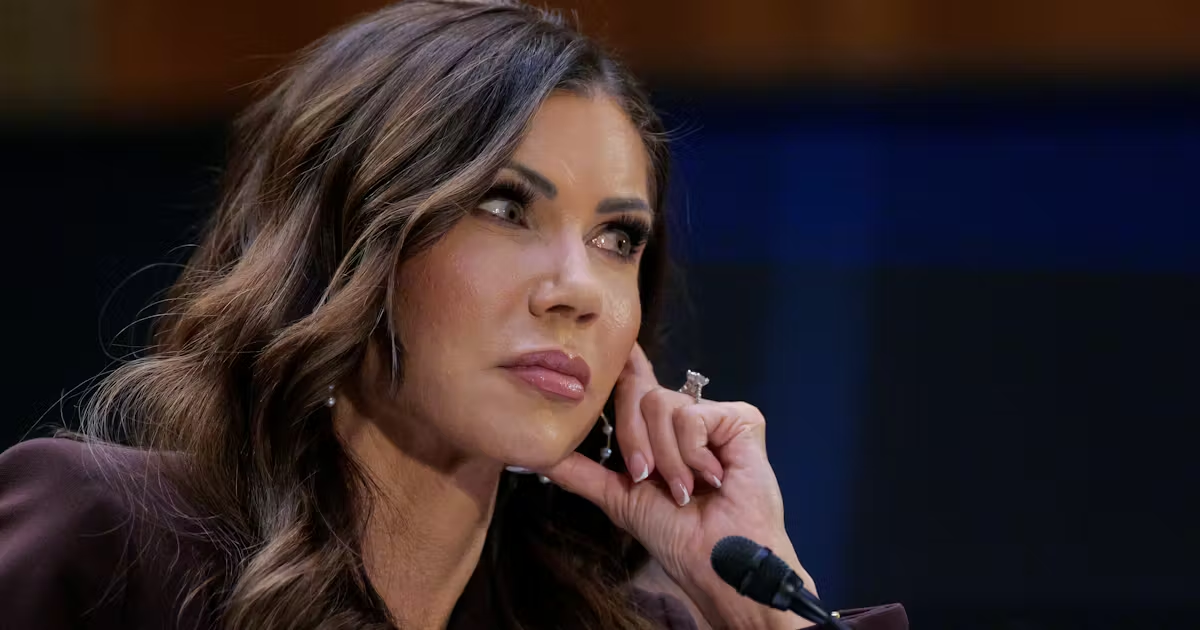
<p>During a Senate Judiciary Committee hearing on Tuesday, Senator Cory Booker questioned Homeland Security Secretary Kristi Noem about DHS and ICE operations. Noem stated she could not provide an “accurate number” of U.S. citizens detained by ICE as of last October; Booker cited public records indicating at least 170 incidents, including 20 involving children.</p><p>Noem said DHS did not detain children or separate them from parents and stated, “We don’t detain American citizens.” Booker referenced the case of Isaias Pena Salcedo, a U.S. citizen held by ICE for 70 hours after presenting a passport. Booker also pressed Noem on warrantless home enforcement and her claimed unfamiliarity with the shooting of U.S. citizen Marimar Martinez in Chicago, displaying text messages in the hearing.</p><p>Noem denied targeted operations in schools; Booker cited instances of agents entering school property, including a January raid at a Minneapolis high school. Booker also cited judicial findings that ICE and DHS violated numerous court orders in Minnesota and New Jersey.</p>