Norms Impact
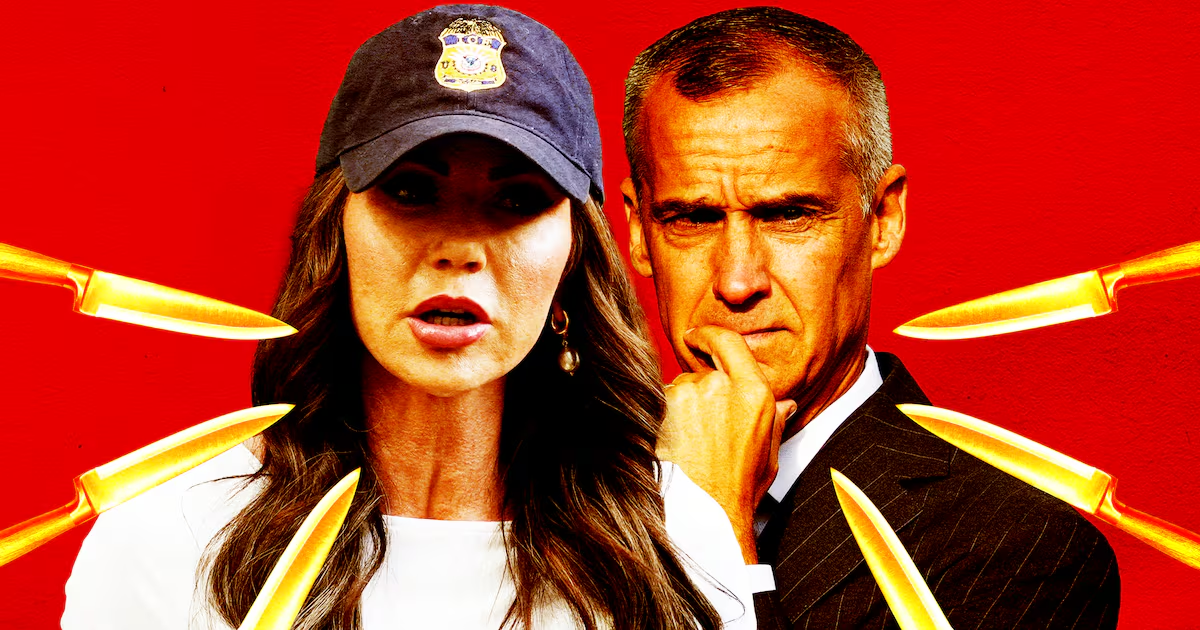
Knives Are Out for ICE Barbie and Her Lover: ‘They’re F***ed’
DHS procurement and oversight norms fracture when an unpaid political confidant is documented approving contracts while the Secretary denies it under oath to Congress.
Mar 10, 2026
⚖ Legal Exposure
Sources
Summary
Kristi Noem was removed as Homeland Security Secretary after congressional hearings and now faces scrutiny over DHS contracts and sworn testimony about Corey Lewandowski’s role in approvals. The episode centers on blurred lines between public authority and informal influence, including allegations that an unpaid adviser functioned as a de facto contracting gatekeeper. The practical consequence is an expanding set of oversight demands—potential hearings and a perjury inquiry—focused on procurement integrity and accountability to Congress.
Reality Check
Permitting informal actors to exercise contracting power while Congress is given denials under oath breaks a core democratic guardrail: accountable, documented public decision-making. When procurement is steered through no-bid awards, loyalty-screened solicitations, and nontransparent approval chains, the executive branch gains a template for spending public money with reduced scrutiny. The sworn-testimony conflict described here reflects prosecutable corruption risk, and normalizing it teaches future officials that oversight can be evaded first and litigated later. Our system cannot hold if congressional inquiry becomes theater while real authority migrates to unaccountable hands.
Legal Summary
Level 3 exposure is driven primarily by the apparent contradiction between Noem’s sworn denial of Lewandowski’s contract-approval role and internal DHS records reportedly showing his approvals, creating strong false-statement/perjury risk. Separately, the no-bid, politically conditioned ad/PR contracting and connected-subcontractor structure present significant structural corruption indicators, but the article does not yet supply direct evidence of payments or personal enrichment needed for definitive bribery/kickback charges.
Legal Analysis
<h3>18 U.S.C. § 1001 — False statements to Congress</h3><ul><li>Noem reportedly testified under oath that Lewandowski had no role in approving contracts (“No”), while internal DHS records reviewed by ProPublica allegedly show Lewandowski personally approved a multimillion-dollar equipment contract and routinely signed as the final internal step before Noem.</li><li>If the internal routing sheets are authentic and reflect actual approval authority, the testimony creates a strong exposure to a knowingly and materially false statement in a matter within federal jurisdiction (Congressional oversight of DHS contracting).</li><li>Key gap for charging: proof of Noem’s knowledge/intent at the time of testimony (e.g., her awareness of Lewandowski’s approvals), though the described records and “chief advisor” sign-offs support an inference of awareness.</li></ul><h3>18 U.S.C. § 1621 — Perjury</h3><ul><li>The article frames the testimony as “under oath” and specifically identifies a categorical denial about Lewandowski’s contract-approval role.</li><li>Perjury exposure turns on whether the denial was willfully false and material; contract-approval authority is material to DHS procurement integrity and potential corruption inquiries.</li><li>Gap: the article does not quote the full oath/setting transcript beyond the exchange, and the precise definition of “role in approving contracts” (formal authority vs. internal routing concurrence) may be contested.</li></ul><h3>18 U.S.C. § 201 — Bribery / Illegal gratuities (structural corruption risk via procurement steering)</h3><ul><li>DHS ad/PR awards were allegedly no-bid to GOP-linked firms, including a subcontractor tied by marriage to a former DHS spokeswoman allied with Noem/Lewandowski; Democratic senators are explicitly probing whether Noem/Lewandowski/DHS staff financially benefited.</li><li>The procurement pattern (no-bid awards, extremely short bid window, and requirement of a track record promoting Trump administration policies) supports an inference of steering access and public funds toward politically connected entities, potentially as a thing of value to allies or for downstream benefit.</li><li>Gap: the article does not allege a specific payment or thing of value flowing back to Noem/Lewandowski, so §201 charging would require proof of personal benefit and linkage to an “official act.”</li></ul><h3>41 U.S.C. § 8702 / 18 U.S.C. § 208 — Kickbacks / Conflicts of interest (investigative exposure)</h3><ul><li>Senators are asking whether any DHS employee (including Noem/Lewandowski) financially benefited from the firms/contracts, indicating live suspicion of kickbacks or conflicted participation.</li><li>Familial/political ties described (subcontractor CEO married to former DHS spokeswoman; allies of Noem/Lewandowski) amplify conflict-risk and potential improper benefit concerns if officials participated personally and substantially in contracting.</li><li>Gap: the article provides no direct evidence of kickback payments or equity/compensation interests held by Noem/Lewandowski.</li></ul><h3>18 U.S.C. § 1343 / § 1346 — Honest-services fraud (public corruption via deprivation of honest services)</h3><ul><li>The combination of politically conditioned procurement language (“promoting Trump administration policies”), no-bid awards to politically connected vendors, and alleged concealment/misrepresentation of Lewandowski’s contracting role creates an appearance of using public office for improper political/personal network benefit.</li><li>Honest-services exposure typically requires bribery/kickback-style quid pro quo; here, the article supplies strong procurement-irregularity signals and concealment risk, but not the necessary proof of a bribe/kickback.</li></ul><b>Conclusion:</b> The article presents a prosecutable-leaning structural corruption risk centered on contracting control and concealment, with the clearest near-term criminal exposure being false statements/perjury tied to Lewandowski’s alleged contract approvals; the procurement facts add substantial corruption indicators pending proof of personal benefit or kickback/bribery linkage.</p>
Detail
<p>Kristi Noem was ousted as Homeland Security Secretary last Thursday after two days of congressional hearings that included questioning about a Minneapolis immigration crackdown, a no-bid $220 million advertising campaign, proposed migrant detention “warehouse” complexes, a $70 million aircraft acquisition, and an ICE vehicle fleet purchase.</p><p>After the hearings, Donald Trump moved Noem to a newly created position as Special Envoy for the Shield of the Americas and named Sen. Markwayne Mullin to replace her effective March 31; Corey Lewandowski, described as her unpaid adviser, is expected to leave DHS as well.</p><p>Democratic senators have written to firms involved in DHS advertising contracts awarded without competitive bidding and asked whether Noem, Lewandowski, or DHS personnel financially benefited. Separately, internal DHS records reviewed by ProPublica show Lewandowski approved a multimillion-dollar equipment contract while signing as “chief advisor,” despite Noem’s sworn statement to Sen. Richard Blumenthal that he had no role in approving contracts. Blumenthal is seeking a perjury investigation.</p>