Musk says taxing every billionaire at 100% would barely make a dent in the national debt. Bernie says tax them 5% and you’re $3,000 richer | Fortune
Musk’s debt math and Sanders’s $3,000-check pitch talk past each other—and most coverage skips what a 5% billionaire wealth tax would actually face in Congress, markets, and courts.
Sources
Summary
Fortune frames a viral Musk claim (100% billionaire confiscation won’t solve the debt) against Sanders/Khanna’s new proposal: a 5% annual wealth tax on U.S. billionaires to fund a one-time $3,000 payment for most households and later social spending. The math comparison is directionally right but incomplete: it mixes stock wealth, annual flows, and implementation realities (avoidance, valuation, constitutionality, and political feasibility). The real buried angle is that both arguments rely on simplified arithmetic while the binding constraints are legal design, enforceability, and fiscal scale relative to structural deficits and rising interest costs.
Reality Check
Confiscating billionaire wealth wouldn’t “solve” a ~$39T federal debt, but a sustained, enforceable 5% wealth tax on billionaires could still raise large sums relative to many programs; the decisive question is not the headline math, but whether such a tax is legally viable, administrable, and politically passable at the claimed revenue levels. (sanders.senate.gov)
Media
Detail
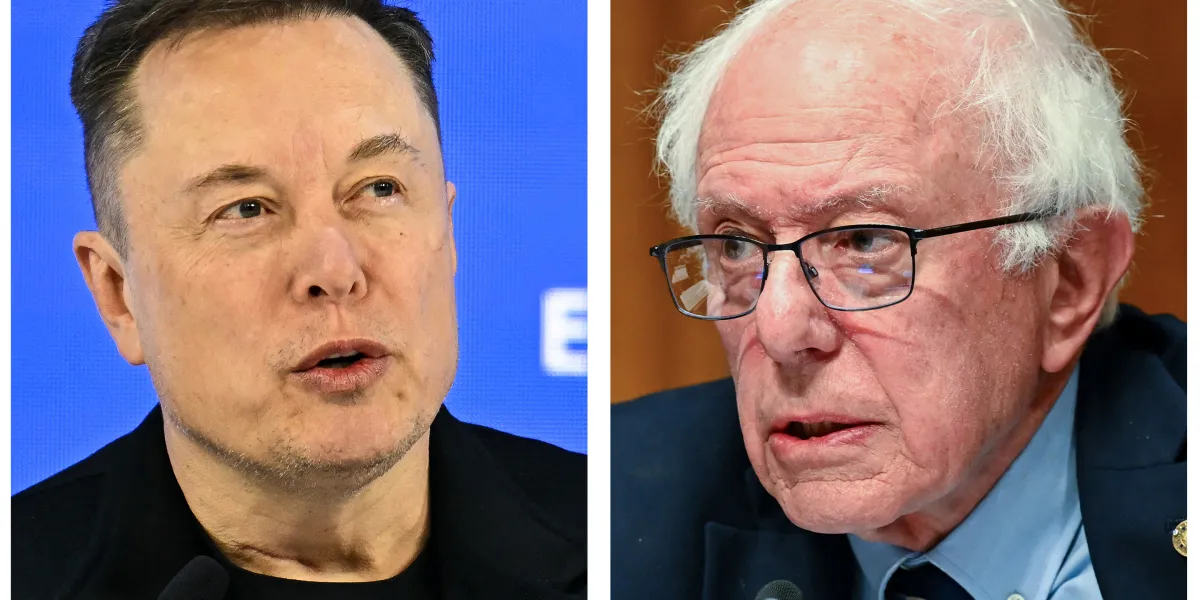
Musk (via a 2023 X post) argues even taxing all U.S. billionaires at 100% would barely dent federal debt (stock-wealth vs debt framing).
Sanders/Khanna introduced the “Make Billionaires Pay Their Fair Share Act”: a proposed 5% annual wealth tax on people with net worth ≥$1B.
Sanders/Khanna cite ~938 U.S. billionaires with combined net worth about $8.2T (as of their release). (sanders.senate.gov)
Sanders claims the proposal raises about $4.4T over 10 years and funds a one-time $3,000 payment for households earning ≤$150k (~74% of Americans), plus later spending priorities. (sanders.senate.gov)
Fortune contextualizes debt/interest: federal debt near $39T; net interest costs are approaching ~$1T/year and projected to keep rising. (jec.senate.gov)
The piece correctly notes Musk is evaluating a billionaire tax as a debt-fix, while Sanders is selling it as redistribution/benefits—not debt retirement.