Conservative Spin
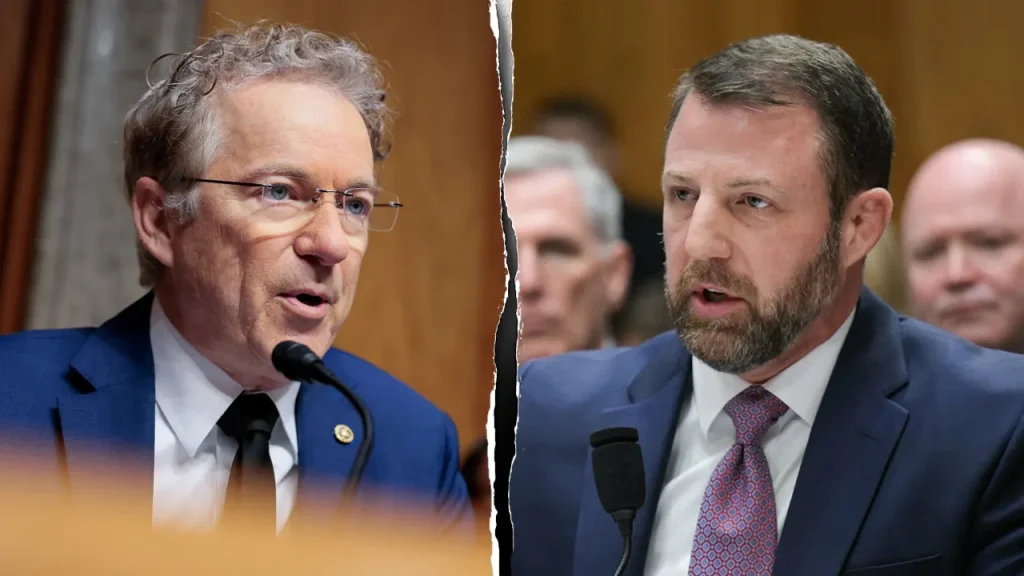
‘Tell me to my face’: Top moments in Mullin’s heated confirmation hearing to be Trump’s next DHS chief
Source
Fox News
'Tell me to my face': Top moments in Mullin's heated confirmation hearing to be Trump's next DHS chief
Claim
Mullin’s hearing shows he’s too volatile and ethically questionable to run DHS, while Democrats’ shutdown tactics—not the nominee—are the real problem.
Facts
President Donald Trump nominated Sen. Markwayne Mullin (R-OK) to be Secretary of Homeland Security, replacing outgoing Secretary Kristi Noem.
Mullin testified on March 18, 2026 before the Senate Homeland Security and Governmental Affairs Committee, chaired by Sen. Rand Paul (R-KY).
Paul criticized Mullin over past remarks about Paul’s 2017 assault and questioned whether Mullin is fit to lead an agency with force authorities.
Sen. Gary Peters (D-MI) questioned Mullin about prior public comments Mullin made about an ICE-involved shooting in Minnesota; Mullin said the words should have been retracted and that he responded without the facts.
Peters also questioned Mullin about an undisclosed trip from 2015–2016; Paul said Mullin should explain it in a classified setting and suggested the committee’s vote could be delayed.
Spin
The piece sells the hearing as a “top moments” spectacle—anger, friendship, and shutdown drama—so the reader experiences confirmation as reality TV instead of a vetting process.
It leans on emotional conflict (the assault exchange), selective spotlighting (Fetterman as the “key” Democrat), and narrative stacking (temperament + shutdown + ICE shooting rhetoric + “shadowy” trip) to create a composite impression that the outcome hinges on personalities and one-liners.
That presentation nudges readers toward a pre-built conclusion—either Mullin as blunt truth-teller unfairly impeded, or Mullin as reckless hothead—without giving the slower, less dramatic substance a fair share of attention, like what the trip actually was, what rules applied, and what the committee can verify.
Active Tactic Breakdowns
Misleading Framing
7/10
Calling it “top moments” and repeatedly stressing “fireworks,” “explosive,” and “heated” shifts the focus from qualifications and record to conflict as the main signal of fitness. The story frames the decision as a temperament soap opera, not an evidence-led confirmation review.
Omitted Context
6/10
The article references a 33-day DHS shutdown and assigns blame via a highlighted quote, but it doesn’t supply the underlying legislative specifics needed to evaluate responsibility or the policy dispute. Likewise, the trip controversy is described as “shadowy” without enough concrete detail to let readers distinguish secrecy from classification constraints.
It inflates a handful of dramatic exchanges into the implied core of the nomination, making the hearing’s loudest moments feel like the most important facts. By clustering separate controversies in one “moment” package, the story magnifies suspicion beyond what’s actually established in the text.
Emotional Loading
6/10
Highly charged language and the opening focus on a violent assault exchange primes moral judgment before the procedural facts. Words like “shadowy” and “embattled” further push the reader toward suspicion and crisis framing.
Narrative Stacking
7/10
The piece chains multiple mini-stories—Paul assault comments, ICE shooting rhetoric, shutdown blame, secret-trip insinuations, and a friendship subplot—into one directional storyline about character and legitimacy. That stacking encourages readers to treat quantity of controversy as proof, even when key details are unresolved or not presented.
What's Missing
What the committee’s actual vote timeline and rules are, what documentation was requested, and what Mullin has already provided (or not) in writing. Without that, the “candor” dispute reads as character theater rather than a defined compliance question.
Basic grounding on the two flashpoints used to judge judgment: what Mullin previously said in full about Paul’s assault, and what is publicly known versus unknown in the Minnesota ICE shooting case (and what Mullin was reacting to at the time).
Reality Check
A confirmation hearing can be combative without proving misconduct or disqualification; “heated” moments are not a substitute for verified findings, especially on issues described as ongoing or classified.
Strip out the highlight-reel packaging and the story mainly shows: a nominee taking heat for past comments, admitting one public statement was made too fast, and a committee dispute over a trip whose details the article does not substantiate. The reader can’t responsibly infer guilt or fitness from drama cues alone.