Norms Impact
Leavitt Admits SAVE Act Will Make It Harder for Married Women to Vote
The White House is pressing Congress to condition federal voting access on new documentation and constant roll purges—normalizing partisan leverage over ballot eligibility and election administration.
Mar 10, 2026
⚖ Legal Exposure
Sources
Summary
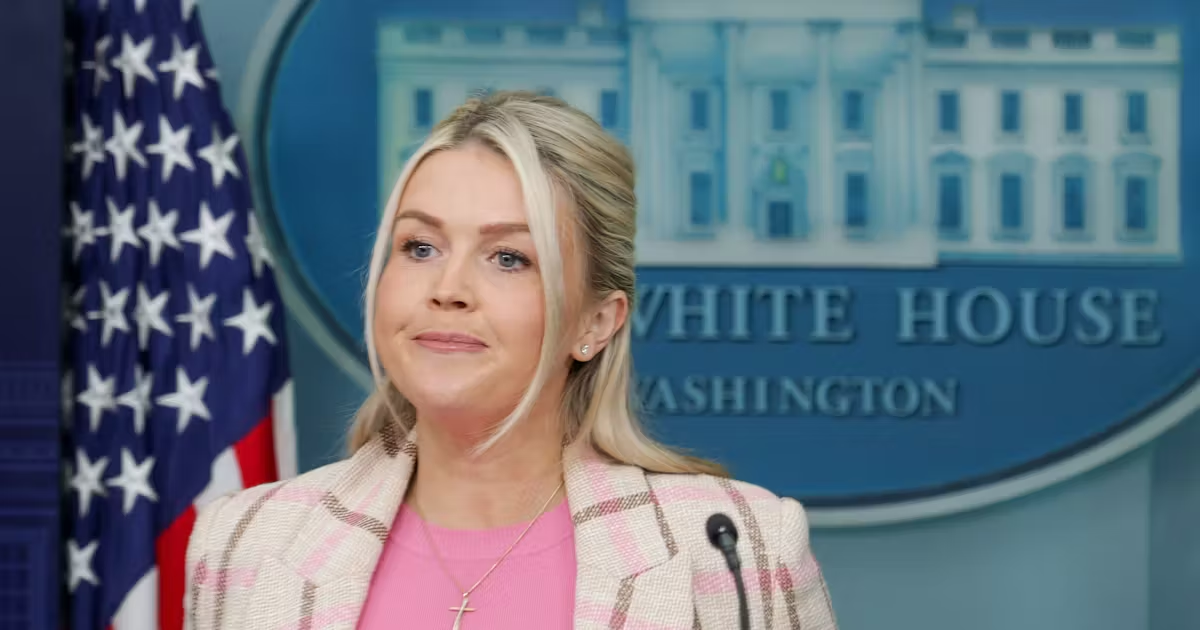
White House press secretary Karoline Leavitt said the SAVE America Act would require married women and others who have changed their name to re-register and update documentation before voting.
The White House is pushing Congress to rewrite federal voter-registration rules by tightening documentary requirements and accelerating mandatory voter-roll purges.
Eligible voters could be delayed or turned away for paperwork and administrative capacity failures, shifting ballot access from a right to a bureaucratic hurdle.
Reality Check
Conditioning ballot access on expanded documentation and constant re-registration shifts power from voters to administrative chokepoints, weakening the norm that eligible citizens should be able to vote without avoidable barriers.
When the presidency ties must-pass governance to election-rule demands and threatens shutdowns to force compliance, our separation-of-powers guardrails erode and election administration becomes a bargaining chip.
Over time, this precedent trains the system to accept procedural exclusion as “integrity,” making it easier to narrow the electorate through bureaucracy rather than persuasion.
Legal Summary
The article describes proposed legislation and executive-branch advocacy that would impose significant new registration and documentation burdens, including on married women who changed their names, with rhetoric implying partisan electoral advantage. On the provided facts, this presents a serious investigative/policy red flag (potential voter-suppression risk) but lacks allegations of a transactional corruption scheme or concrete unlawful implementation sufficient to support criminal charges.
Legal Analysis
<h3>18 U.S.C. § 241 — Conspiracy Against Rights</h3><ul><li>The article describes proposed federal legislation that would impose new registration/documentation burdens (proof of citizenship/residency, voter ID, frequent roll purges) that could foreseeably impede eligible voters; however, it does not allege an agreement among officials to unlawfully injure or oppress voters in the exercise of voting rights.</li><li>Statements that the bill would “guarantee the midterms” suggest partisan motive, but motive alone (without coordinated unlawful means or evidence of conspiratorial implementation) is insufficient on this record.</li></ul><h3>52 U.S.C. § 10307 — Voting Rights Protections (Intimidation/Coercion/Interference)</h3><ul><li>The article alleges structural burdens and administrative hurdles that could result in eligible voters being “sent away” due to documentation, but it does not allege intimidation, threats, coercion, or unlawful interference tactics by identifiable actors beyond advocacy for a policy change.</li><li>The described impact is prospective and policy-based (pending passage), not an alleged illegal enforcement action.</li></ul><h3>18 U.S.C. § 242 — Deprivation of Rights Under Color of Law</h3><ul><li>There is no allegation of an executed deprivation under color of law; the article focuses on proposed legislative changes and public messaging by the White House press secretary.</li><li>A prior court rebuke of an earlier voter-ID effort is referenced, but no specific current, unlawful implementation action is alleged here.</li></ul><h3>Ethics / Abuse-of-Power (Non-statutory political irregularity)</h3><ul><li>Leavitt’s acknowledgment that married women and others who changed names would need to update documentation and re-register reflects a foreseeable disparate administrative burden; however, the article provides no evidence of personal enrichment, payments, or transactional exchange.</li><li>Trump’s pressure on lawmakers (e.g., threatening a shutdown to force passage) is hardball politics as described, not a money-access-official-act quid pro quo in the provided facts.</li></ul><b>Conclusion:</b> The conduct described is best characterized as a serious investigative/policy red flag regarding potential voter-access burdens and partisan pressure tactics, not prosecutable structural corruption or a clearly chargeable civil/criminal voting-rights offense on the stated facts.</p>
Media
Detail
<p>During a Tuesday briefing in the White House press room, press secretary Karoline Leavitt responded to a reporter about the SAVE America Act’s effect on married women. She first said married women who changed their names would be “entirely unaffected,” then said that individuals who have changed their name or address would need to use state processes to update documentation and re-register before voting.</p><p>As described, the SAVE America Act would amend the National Voter Registration Act of 1993 by requiring proof of citizenship and proof of residency to register, requiring voter ID, abolishing mail-in voting, and mandating voter-roll purges every 30 days. The text also includes provisions unrelated to voter registration, including restricting men from competing in women’s sports and banning “transgender mutilation surgery.”</p><p>Donald Trump directed House Republicans to pass a revised version and said he would not sign other legislation until it passes, including stating he would “close government over” the issue.</p>