Norms Impact
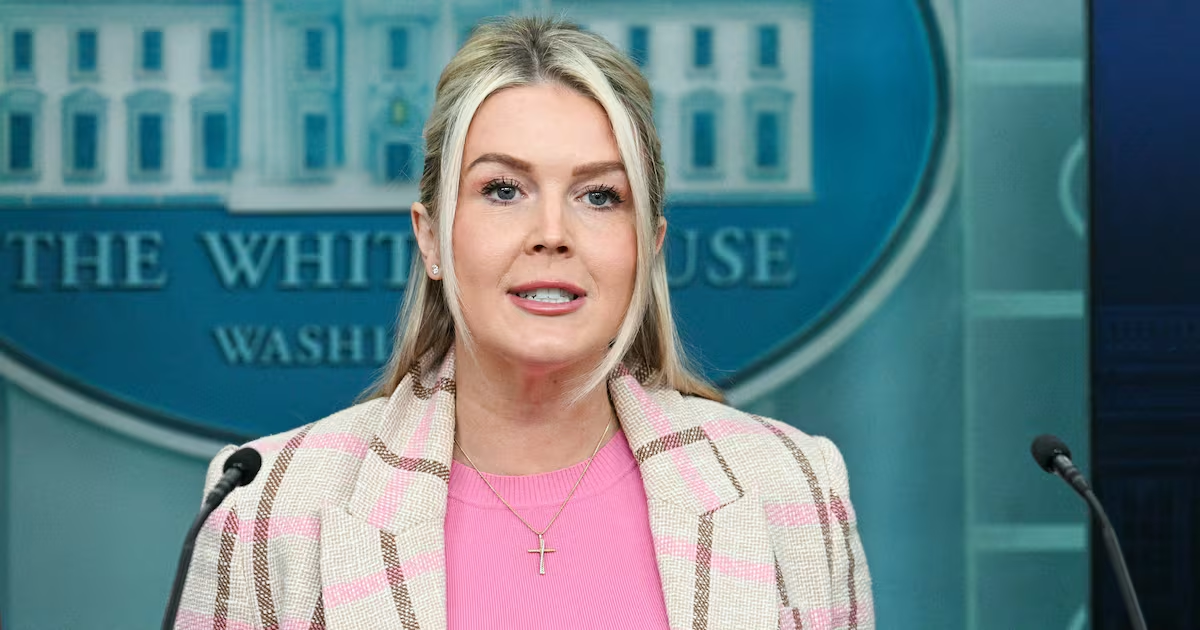
Leavitt Snaps at CBS Reporter for Asking About Trump’s Serial Fabrications
A president’s shifting, unverified claims were used to justify war while the White House disputed the Pentagon’s account to Congress—fracturing the norm that force follows accountable, evidence-based scrutiny.
Mar 10, 2026
Sources
Summary
The White House defended President Donald Trump’s stated justification for striking Iran after he claimed Iran was poised to attack U.S. targets within days and made other assertions he later said he could not prove. The administration’s public case for war leaned on assertions framed as “feelings” and undisclosed intelligence while disputing the Pentagon’s account to Congress that no intelligence showed Iran was planning to attack first. The practical consequence is a lowered threshold for initiating military action, with the public asked to accept shifting claims without verifiable evidentiary grounding.
Reality Check
When the executive branch normalizes launching war on shifting assertions framed as undisclosed “intelligence” or personal “feelings,” we lose the evidence-based guardrails that restrain unilateral force. Disputing what the Pentagon has told Congress while withholding verifiable support conditions the public to accept military action without accountable proof. Over time, this precedent weakens separation-of-powers oversight by making congressional and public scrutiny optional rather than binding. Our democracy cannot sustain war powers that operate on uncheckable claims and retreating statements instead of transparent, testable justification.
Detail
<p>At a White House press briefing Tuesday, Press Secretary Karoline Leavitt responded to questions from CBS News Chief White House Correspondent Nancy Cordes about President Donald Trump’s claims used to justify U.S. military action against Iran.</p><p>Cordes asked whether Trump was “making this up” after noting that neither U.S. nor Israeli leaders were making the same claims. Leavitt replied that the president “is not making anything up,” stating he was relying on “intelligence” and “facts” consumed by him and his negotiators.</p><p>Leavitt repeated the White House claim that Iran was going to attack the United States, while disputing the Pentagon’s communication to Congress that there was no intelligence suggesting Iran planned to attack first.</p><p>The exchange followed Trump’s Monday remarks in Florida asserting Iran would attack U.S. targets “within a week,” then offering additional shifting statements about his rationale for launching “Operation Epic Fury,” describing it as a “feeling” based on “facts.”</p><p>Trump also suggested Iran struck a girls’ school in Iran with a Tomahawk missile, then later said he had no proof and “just don’t know enough about it.”</p>