Norms Impact
Live Updates: Trump Ousts Noem as Homeland Security Secretary
Trump removed the homeland security secretary under congressional scrutiny and reassigned her into a newly invented envoy post, further normalizing personal command over cabinet accountability.
Mar 5, 2026
⚖ Legal Exposure
Sources
Summary
President Trump fired Homeland Security Secretary Kristi Noem and said he plans to replace her with Senator Markwayne Mullin of Oklahoma. The move combines cabinet turnover with the creation of a new, previously nonexistent envoy role for a displaced official. The result is a reshuffling of leadership atop the department executing a central second-term priority: mass deportations.
Reality Check
When a president can publicly contradict sworn testimony tied to government contracting and then rapidly reshuffle a cabinet post, oversight loses its practical force. Creating a previously nonexistent envoy role for an ousted cabinet official signals that removal can be paired with reassignment, weakening the expectation that misconduct concerns trigger independent scrutiny and consequences. Over time, this conditions our institutions to treat executive personnel moves as substitutes for accountability, narrowing Congress’s ability to enforce transparent governance.
Legal Summary
The strongest exposure arises from the inspector general’s allegations that DHS leadership blocked and conditioned OIG access in ways that could impede audits and a pending criminal inquiry, creating potential obstruction risk and clear oversight/IG Act concerns. Separately, the public contradiction of Noem’s sworn testimony about the $220 million ad campaign raises a material false-statement investigative predicate. The record shows procedural/oversight interference and procurement-appearance issues rather than a developed transactional corruption scheme.
Legal Analysis
<h3>5 U.S.C. app. 3 (Inspector General Act of 1978) — Interference/denial of IG access</h3><ul><li>DHS Inspector General alleged the department blocked or revoked OIG access to multiple databases and information systems, despite OIG’s asserted statutory “right of access” to records relating to DHS programs and operations.</li><li>The IG alleged DHS attempted to condition access on inspectors revealing investigative details to individuals who could be related to allegations/targets, creating an inference of improper interference with independent oversight.</li><li>Gap: Article does not specify the precise legal basis DHS claimed (e.g., national security) for each denial; it notes DHS did not invoke national security/counterintelligence authority while blocking access.</li></ul>
<h3>18 U.S.C. § 1505 — Obstruction of proceedings before departments/committees</h3><ul><li>Pattern of allegedly denying OIG access to “vital” intelligence databases for a pending criminal inquiry and other investigations could constitute corrupt obstruction if done to impede an inquiry within an executive department.</li><li>The IG’s description of “particularly egregious” conduct tied to a “specific pending criminal investigation” supports a prosecutorial inference of intent to impede, especially where access was conditioned on disclosures risking compromise.</li><li>Gap: The article does not identify the underlying criminal investigation, the targets, or specific obstructive acts beyond access denials/conditions, limiting ability to conclude all elements are met.</li></ul>
<h3>18 U.S.C. § 1001 — False statements (risk area: congressional testimony)</h3><ul><li>The President publicly contradicted Noem’s sworn Senate testimony that Trump had signed off on a $220 million border-security advertising campaign featuring her; if either account is false and material, exposure could attach to the declarant.</li><li>Sen. Kennedy’s statement that the President called about her testimony, coupled with conflicting recollections, creates an investigative predicate to assess materiality and knowledge/intent.</li><li>Gap: The article provides no definitive proof of falsity, only conflicting statements; further evidence (documents, approvals, communications) would be required.</li></ul>
<h3>5 C.F.R. Part 2635 / Procurement integrity (ethics & contracting process) — Preferential contracting appearance</h3><ul><li>The $220 million ad campaign was scrutinized because the firm handling it was connected to the husband of Noem’s former spokeswoman, and the ads prominently featured Noem, raising appearance-of-preferential-treatment/self-promotion concerns.</li><li>Noem asserted a “competitive process” with no political appointee involvement and that it was “done correctly, all done legally,” which, if inaccurate, heightens investigative concern around procurement integrity and misuse of office.</li><li>Gap: Article does not establish bribery/kickbacks, personal payment, or concrete procurement rule violations—only structural red flags and oversight scrutiny.</li></ul>
<b>Conclusion:</b> The article supports serious investigative red flags involving alleged interference with inspector general access and potential obstruction dynamics, plus possible false-statement exposure tied to sworn testimony; it does not establish a money-for-official-act quid pro quo or fully satisfy criminal elements on the current record.
Detail
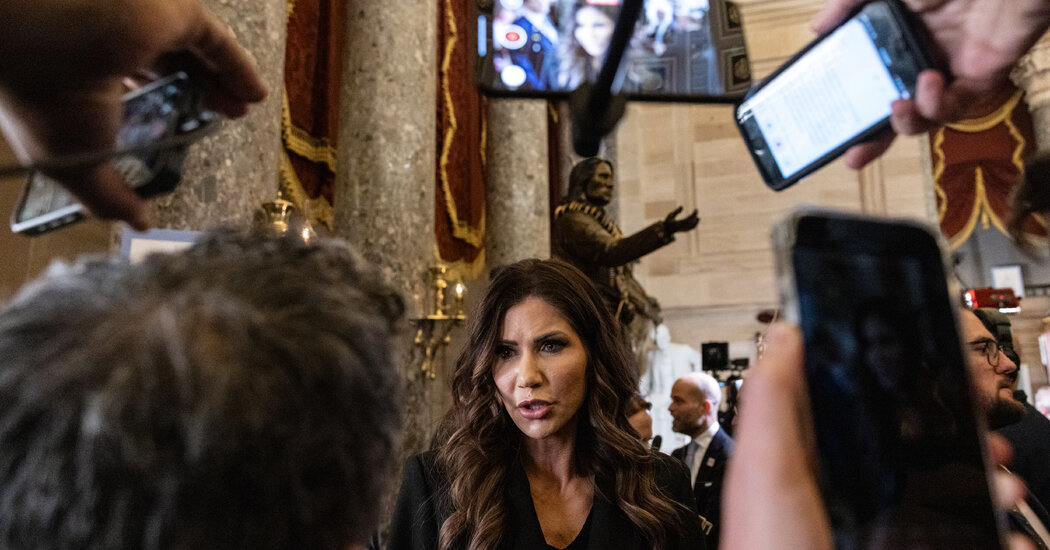
<p>On Thursday, President Trump announced on social media that Kristi Noem was out as secretary of the Department of Homeland Security and that he intended to nominate Senator Markwayne Mullin of Oklahoma as her replacement. Trump also announced a new role for Noem as “special envoy for the Shield of the Americas,” describing it as a new Western Hemisphere security initiative.</p><p>Noem’s dismissal followed congressional hearings this week in which Republican lawmakers questioned her on multiple topics, including her knowledge of a $220 million border-security advertising campaign that prominently featured her. At a Senate hearing Wednesday, Noem said under penalty of perjury that Trump had signed off on the campaign; on Thursday, Trump told Reuters he “never knew anything about it.” Senator John Kennedy said Trump called him about Noem’s testimony and that the two accounts differed.</p><p>Noem was the first cabinet member ousted in Trump’s second term and had been a key figure in carrying out the administration’s mass deportation effort.</p>