Norms Impact
‘Oh Come on,’ Says Senate Democrat After Jake Tapper Plays Voting-Against-the-Troops Card | Common Dreams
A president wages costly hostilities while preparing a massive funding ask, testing whether Congress will normalize war-by-spending without clear democratic consent.
Mar 8, 2026
Sources
Summary
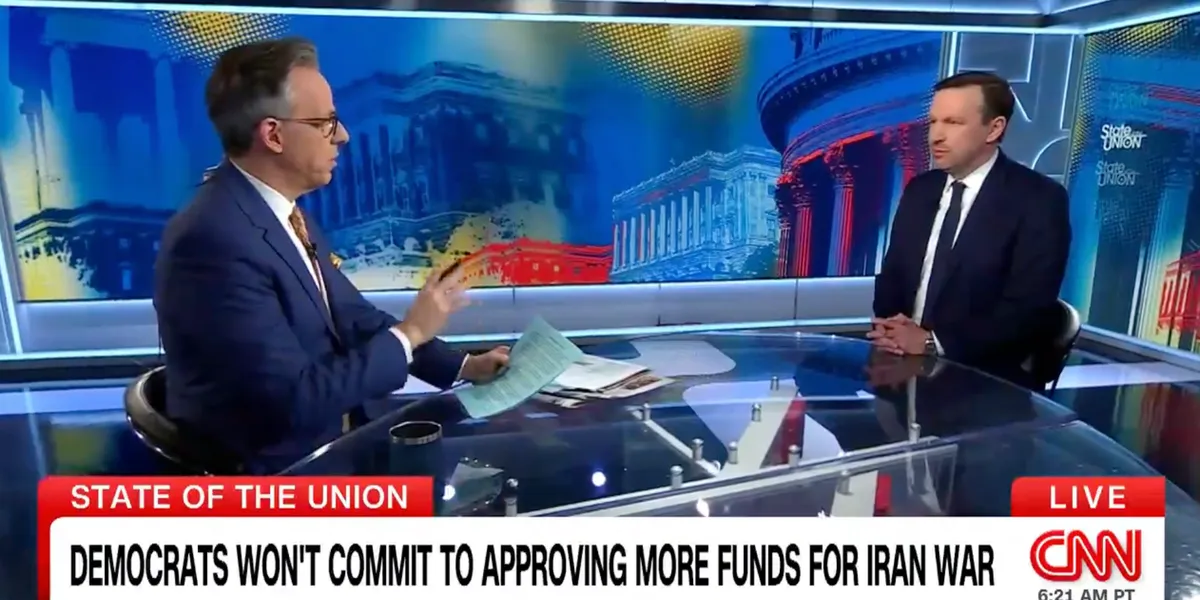
Sen. Chris Murphy publicly rejected CNN anchor Jake Tapper’s framing that voting against President Donald Trump’s expected $50 billion Iran-war funding request would mean “voting against the troops.” The exchange reflects a renewed struggle over Congress’s war-funding role as the president continues military operations while seeking additional appropriations. The practical consequence is a high-stakes vote that will determine whether Congress finances expanded hostilities that multiple senators describe as an illegal war of choice.
Reality Check
The democratic danger is the normalization of sustained military action that proceeds first and seeks large-scale funding later, conditioning our system to treat war as a budget line rather than a constitutional choice. When war costs escalate toward $1 billion per day while Congress debates whether opposing funds is “against the troops,” our civilian oversight is reshaped by coercive framing instead of accountable authorization.
This precedent weakens separation-of-powers guardrails by shifting the center of gravity from public deliberation to executive momentum. If Congress cannot assert its role over war funding without being rhetorically branded as disloyal, future presidents will learn that initiating hostilities is easier than ending them—and that democratic consent can be manufactured after the fact.
Media
Detail
<p>On Sunday, Sen. Chris Murphy (D-Conn.) pushed back after CNN anchor Jake Tapper said a vote against an expected $50 billion funding request by President Donald Trump for his attack on Iran would be seen as “voting against the troops.” Murphy responded that the public does not want another long-term Middle East war and argued that supporting troops means voting against war funding to keep service members out of harm’s way.</p><p>Trump has not yet submitted a formal request for the $50 billion, but estimates cited place the cost of military operations so far at roughly $1 billion per day, with one week of fighting estimated at about $1 billion per day. Murphy said he is a “hell no” on any additional funding, and other Democratic senators echoed opposition. Sen. Chris Van Hollen (D-Md.) said Trump is already spending $1 billion per day on what he called an “illegal regime change war of choice” and will seek up to $50 billion more. Sen. Patty Murray (D-Wash.) criticized the spending as increasing costs and contributing to higher gas prices.</p>