Norms Impact
Trump Reveals Why There’s No Evacuation Plan for Trapped Americans
A U.S. strike launched without an evacuation plan left Americans stranded abroad while the government pointed them to commercial travel and embassy contact tools instead of organized protection.
Mar 3, 2026
⚖ Legal Exposure
Sources
Summary
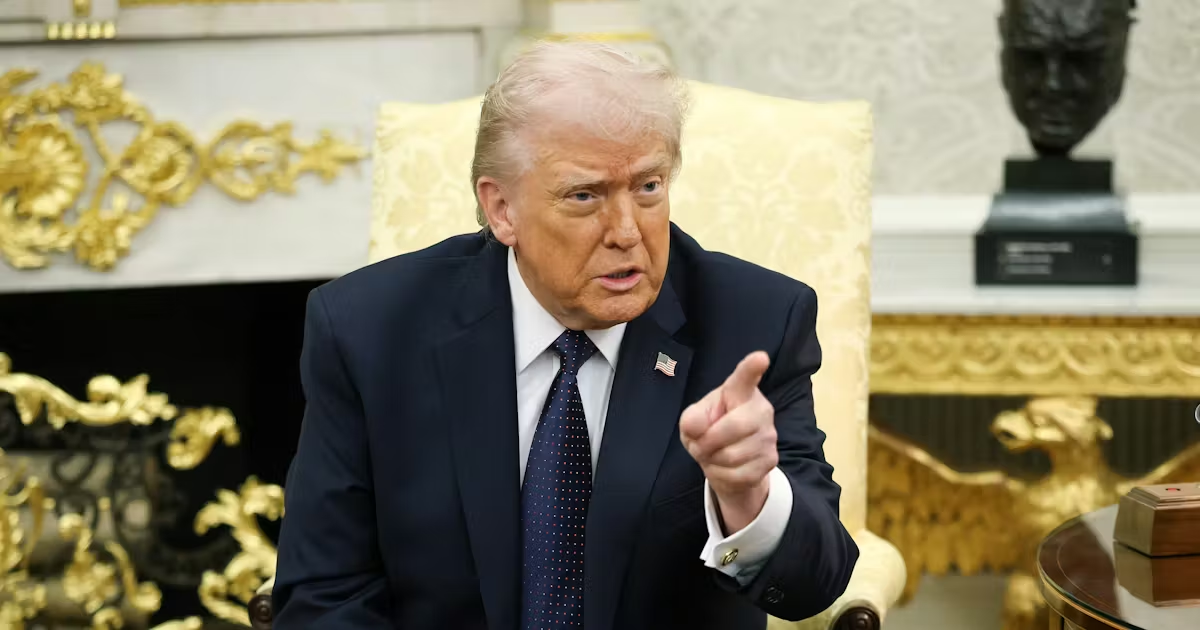
President Donald Trump said at the White House that he did not have an evacuation plan for Americans in the Middle East before bombing Iran, as thousands were reported stranded with flights grounded.
U.S. embassies and the State Department shifted responsibility to individuals by directing Americans to use available commercial transportation and enrollment tools rather than organizing government evacuation.
Americans in multiple countries facing Iranian or Israeli attacks were left with limited exit options during closed airspace and escalating conflict.
Reality Check
Normalizing major military action without a credible plan to protect U.S. civilians abroad weakens the basic expectation that executive war decisions include operational responsibility for foreseeable civilian fallout.
When our government responds to stranded citizens by shifting burden to “available commercial transportation” and limited contact programs, it conditions the public to accept abandonment as standard crisis governance.
Over time, that precedent erodes accountability for the use of force and expands executive latitude to act first and improvise later, leaving civilians to absorb the consequences.
Legal Summary
The article supports exposure primarily as a serious procedural/governance irregularity: initiating military action without an evacuation plan and issuing guidance implying limited government assistance to stranded Americans. It lacks any allegations of personal enrichment, bribery, or a money-to-official-action quid pro quo, and it does not provide facts sufficient to support criminal civil-rights or fraud theories. Overall, this is best characterized as an investigative/oversight red flag, not structural corruption on the stated facts.
Legal Analysis
<h3>18 U.S.C. § 242 (Deprivation of Rights Under Color of Law)</h3><ul><li>Article alleges no evacuation plan and State Department guidance that stranded citizens are “on their own,” but it does not allege intentional deprivation of a specific constitutional/federal right by willful misconduct.</li><li>Gap: negligence/incompetence in crisis planning, without willfulness and a cognizable right to evacuation, is typically insufficient for §242 criminal exposure on these facts.</li></ul><h3>18 U.S.C. § 371 (Conspiracy to Defraud the United States)</h3><ul><li>The article describes apparent lack of planning and delayed/ineffective guidance, but does not allege an agreement, deceptive scheme, or corrupt interference with lawful government functions.</li><li>Gap: no facts indicating coordinated deceit, concealment, or misuse of government processes; reads as operational failure rather than fraud.</li></ul><h3>31 U.S.C. § 1341 (Anti-Deficiency Act) / Appropriations Misuse (Administrative/Civil Exposure)</h3><ul><li>No allegation of unlawful expenditure/obligation or misuse of appropriated funds related to evacuations; therefore no basis to infer ADA violations from the described conduct.</li></ul><h3>War Powers / Use-of-Force Legality (Non-criminal Constitutional/Statutory Dispute)</h3><ul><li>Senators characterize the strike as “illegal,” but the article provides no details on authorization, statutory basis, or facts necessary to assess criminal applicability; this is principally a constitutional/war-powers controversy, not a prosecutable corruption matter on the provided facts.</li></ul><b>Conclusion:</b> The described conduct reflects serious governance and readiness irregularities (potentially actionable through oversight/political remedies), but the article does not present a money-access-official-action transactional structure or facts supporting prosecutable public-corruption crimes; exposure is an investigative red flag rather than structural bribery/extortion.
Media
Detail
<p>During a White House meeting Tuesday with German Chancellor Friedrich Merz, a reporter asked President Donald Trump why there was no evacuation plan for “thousands of Americans” stranded in the Middle East. Trump responded that events “happened all very quickly” and said he thought the United States was going to be attacked, without describing any evacuation preparations.</p><p>U.S. embassies in the region warned stranded U.S. citizens that they are on their own after the State Department urged Americans in 14 countries to use any “available commercial transportation” to evacuate. White House press secretary Karoline Leavitt directed Americans to the State Department’s Smart Traveller Enrolment Program to facilitate contact between expatriates and U.S. embassies.</p><p>Politicians criticized the administration’s handling on social media, including complaints about warnings issued days into the conflict while airspace was reported closed and assertions that Americans had limited options and no government assistance.</p>