Norms Impact
Trump Steamrolls Pentagon Pete With Wild War Claim
A president publicly dictated the Pentagon’s wartime story over an active investigation, signaling that military accountability will be subordinated to presidential messaging.
Mar 8, 2026
⚖ Legal Exposure
Sources
Summary
Donald Trump publicly overrode Defense Secretary Pete Hegseth’s statement that the Pentagon was investigating whether U.S. forces struck an Iranian girls’ school, insisting instead that Iran did it. The executive set a public line on disputed battlefield facts while the Defense Department’s own assessment remained tentative and under review. The result is a war narrative shaped from the top down, narrowing space for accountable investigation as civilian deaths and escalation pressures mount.
Reality Check
When a president declares disputed facts in an active military investigation, we normalize executive control over truth in war and weaken the guardrails that force accountability for civilian harm. This precedent pressures defense leadership to conform publicly, even when internal assessments are tentative and subject to change.
Over time, that dynamic corrodes civilian oversight in the way it is supposed to function: not as loyalty enforcement, but as truthful reporting to the public and to Congress. If wartime facts become a presidential talking point rather than an evidence-based finding, democratic checks on the use of force and its consequences lose their practical meaning.
Legal Summary
Exposure is best assessed as a Level 2 investigative red flag: the article depicts public narrative-shaping and apparent pressure on the Pentagon chief while an investigation is ongoing, amid reporting that preliminary assessments conflict with the President’s claim. However, the context provided lacks transactional structure (money/access/benefit) and does not supply the elements needed to charge a clear criminal public-corruption offense based solely on these facts.
Legal Analysis
<h3>18 U.S.C. § 1001 — False Statements (executive-branch matter)</h3><ul><li>The article describes the President publicly asserting the school strike “was done by Iran,” while anonymous U.S. officials and other reporting cited in the article indicate preliminary assessments that American forces are likely responsible; if any materially false statements were made to federal investigators or in official reports (not just public remarks), §1001 exposure could arise.</li><li>Gaps: the context provided is a press interaction aboard Air Force One; §1001 generally requires a materially false statement made “in any matter within” federal jurisdiction, typically to the government—not merely to the public.</li></ul><h3>18 U.S.C. § 371 — Conspiracy (to defraud the United States / obstruct lawful functions)</h3><ul><li>The reported dynamic—publicly directing a narrative inconsistent with preliminary internal assessments while the Pentagon “is investigating”—could be an investigative red flag for improper interference with the integrity of a federal fact-finding process.</li><li>Gaps: no allegation of an agreement, overt acts to obstruct, or specific steps taken to impede investigators beyond public messaging.</li></ul><h3>5 C.F.R. Part 2635 — Standards of Ethical Conduct (executive-branch ethics / integrity of official communications)</h3><ul><li>The described pressure on the Pentagon head to echo the President’s preferred account, despite an ongoing investigation, raises an ethics/integrity concern about politicizing operational facts and accountability for civilian-casualty incidents.</li><li>Gaps: ethics rules do not themselves establish criminal liability; the article does not allege misuse of funds, gifts, or personal financial benefit.</li></ul><b>Conclusion:</b> The facts described reflect a serious investigative red flag and potential politicization/pressure around an ongoing military incident investigation, but the article does not present a money-access-official-action quid pro quo or sufficiently developed statutory elements for a clearly prosecutable corruption offense on the provided record.</p>
Media
Detail
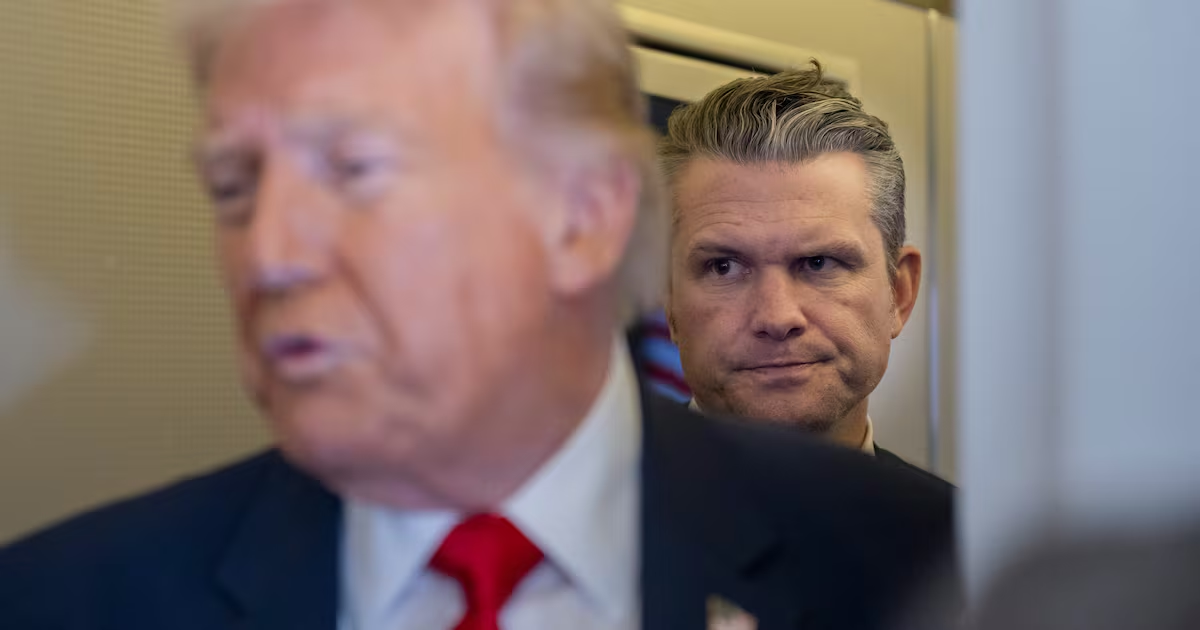
<p>Aboard Air Force One on Saturday, Donald Trump was asked about reports that a girls’ school in Minab, Iran, was struck by the United States during joint Israeli-U.S. strikes. A reporter pressed Defense Secretary Pete Hegseth, standing behind Trump, to confirm the claim; Hegseth replied that the Pentagon was “certainly investigating,” and added that “the only side that targets civilians is Iran.” Trump immediately interrupted to assert, “We think it was done by Iran,” and repeated that claim while stating the Iranian military is “very inaccurate” and that “they have no accuracy whatsoever.”</p><p>The Shajareye Tayabeh girls’ school was hit by three missiles early Feb. 28, with a reported death toll of 165 to 180, mostly girls aged 7 to 12; funerals were held March 3. Two anonymous U.S. officials said preliminary assessments reportedly suggest American forces are likely responsible, though the assessment is tentative and investigations are ongoing. The Pentagon has declined to comment beyond saying it is “investigating.”</p>