Norms Impact
Watch This GOP Senator Learn in Real Time Why the SAVE Act Is Bad
A federal voting bill advances documentation barriers that would predictably block eligible citizens from the ballot, normalizing disenfranchisement as a tool of election policy.
Mar 12, 2026
⚖ Legal Exposure
Sources
Summary
Senate Judiciary testimony described the SAVE Act’s voter-ID standards as requiring documents many Americans do not possess, including passports, and creating additional proof hurdles for name changes. The exchange underscored a shift toward federal election rules that tighten access to the ballot through documentation barriers rather than demonstrated fraud prevention. The practical consequence would be eligible voters being unable to register or vote due to cost, delay, and paperwork requirements.
Reality Check
When federal power is used to raise documentary barriers to voting without a demonstrated need, we normalize disenfranchisement as a governing instrument rather than treating ballot access as a protected democratic baseline. Conditioning participation on passports, fees, waiting periods, and complex name-change paperwork shifts elections toward administrative gatekeeping that predictably excludes eligible voters. That precedent weakens electoral integrity by redefining “security” as restricting the electorate, making future rollbacks easier to impose and harder to unwind.
Legal Summary
The described conduct centers on advancing legislation alleged to make voting harder (passport/birth-certificate burdens), which raises democratic-integrity and ethics concerns. The article does not allege bribery, personal enrichment, coercion, or concrete criminal acts in election administration. On these facts, exposure is primarily an ethics/political irregularity issue rather than a prosecutable corruption scheme.
Legal Analysis
<h3>18 U.S.C. § 241 — Conspiracy against rights</h3><ul><li>Article alleges the SAVE Act would impose documentation requirements that predictably prevent some eligible voters from registering/voting, but it does not allege an agreement among specific actors to injure or oppress voters, nor any coordinated unlawful scheme beyond policy advocacy.</li><li>No facts of threats, intimidation, ballot tampering, or coordinated deprivation activity are described—only legislative design/effects.</li></ul><h3>52 U.S.C. § 10307 — Prohibited acts (voting rights)</h3><ul><li>Conduct described is the advancement of a federal bill that may have disparate disenfranchising effects; the article does not allege falsification of registration, fraudulent denial of ballots, or coercive practices by officials administering elections.</li><li>Absent allegations of discriminatory intent tied to protected classes or unlawful administration, exposure remains primarily political/ethical rather than clearly prosecutable under this section.</li></ul><h3>5 U.S.C. ch. 131 / Senate Ethics Rules — Misuse of office / improper purpose (ethics)</h3><ul><li>Article asserts an “ultimate goal” to reduce voting and “rig elections,” framing the conduct as abuse-of-power motivation; however, it is presented as political inference/criticism rather than evidence of a transactional corruption scheme.</li><li>No money/access/official-act quid pro quo, personal enrichment, bribery, or coercive official conduct is alleged.</li></ul><b>Conclusion:</b> The article describes a policy-driven voting-access controversy and alleged improper partisan motive, but it lacks transactional structure or concrete unlawful acts; exposure is best characterized as an ethics/political integrity issue rather than prosecutable structural corruption on the stated facts.
Media
Detail
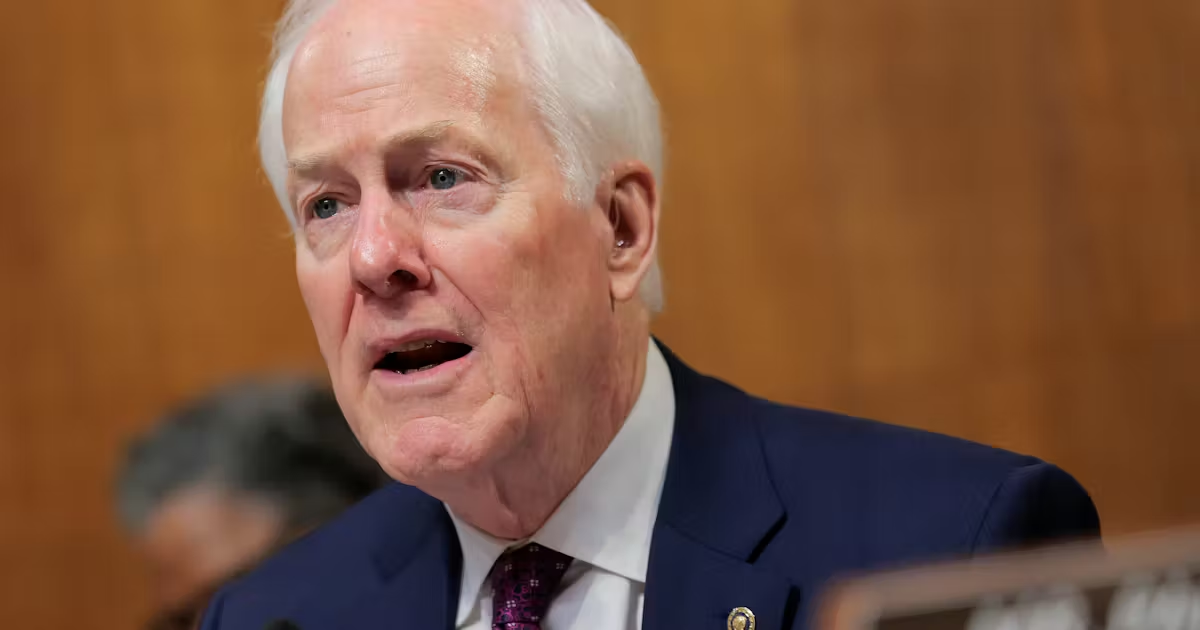
<p>At a Senate Judiciary hearing on Thursday, Sen. John Cornyn said he did not understand how the SAVE Act could disenfranchise millions of Americans and asked for an explanation. Sen. Dick Durbin responded that the bill’s voter ID requirements would not be satisfied by a driver’s license and would instead require a passport or other documents. Durbin stated that about half of Americans do not have a passport and that obtaining one would cost $186 and take three to four weeks. He said the bill would allow use of a birth certificate, but voters who changed their name due to marriage would need additional documentation beyond a birth certificate to prove eligibility to register. Durbin cited an estimate that 9% of U.S. voters do not have the identification required under the bill and said those voters ultimately would not vote. Cornyn asked whether the concerns could be addressed through amendments, and Durbin replied by questioning when the Senate last amended a bill.</p>