U.S. May Have Committed War Crime In Sinking Of Iranian Ship
U.S. leaders celebrated a naval killing while declining to explain why America’s duty to rescue shipwrecked sailors was treated as optional.
Mar 6, 2026
⚖ Legal Exposure
Sources
Summary
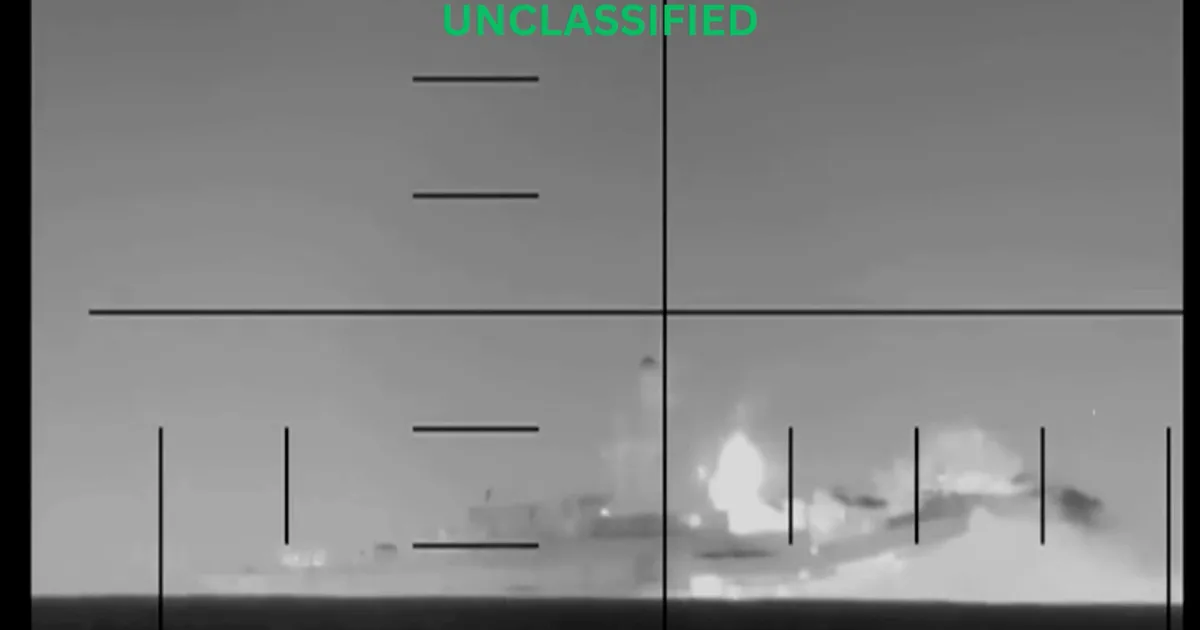
A U.S. Navy submarine torpedoed Iran’s frigate Dena in international waters off Sri Lanka and did not attempt to rescue sailors from the water as the ship sank. Senior U.S. officials publicly celebrated the strike while the Pentagon declined to discuss post-engagement actions, even as legal experts cited an affirmative duty under the Geneva Conventions to search for and collect shipwrecked personnel. The immediate consequence is a precedent that can invite reciprocal mistreatment of American forces while eroding expectations that U.S. military operations will follow the law of armed conflict.
Reality Check
Normalizing the idea that U.S. forces can strike at sea and leave survivors to fate weakens one of the oldest guardrails in armed conflict: the duty to protect shipwrecked personnel. When our government signals that compliance with the Geneva Conventions is discretionary, it conditions adversaries to treat American sailors and aircrews as disposable when they are downed, captured, or stranded. Over time, this degrades rule-following inside our own institutions, because public celebration replaces accountability for how force is used and how life is safeguarded after the shooting stops.
Legal Summary
Allegations that a U.S. submarine sank an Iranian warship and then failed to take any feasible steps to rescue or protect shipwrecked sailors create substantial war-crimes exposure under the law of armed conflict, subject to factual development on feasibility and military exigency. The absence of disclosed operational details leaves key elements unresolved, but the timing (immediate sinking) and asserted complete non-assistance elevate this beyond a mere procedural irregularity. Pending investigation, the conduct reflects a potentially prosecutable law-of-war violation rather than a simple policy dispute.
Legal Analysis
<h3>18 U.S.C. § 2441 — War crimes (grave breaches / violations of Common Article 3 when applicable)</h3><ul><li>Alleged facts indicate a U.S. Navy submarine torpedoed an Iranian frigate in international waters and then “did not attempt to rescue” sailors in the water, leaving recovery to Sri Lankan authorities after at least an hour; experts cite an “affirmative duty to rescue” shipwrecked personnel.</li><li>If the failure to take “all possible measures” to search for, collect, and protect shipwrecked sailors is not justified by “military exigencies,” it can support a war-crime theory tied to denial of required protections to persons rendered hors de combat at sea.</li><li>Element gap: the article does not establish the underlying armed-conflict classification, command intent, or whether feasible rescue measures (e.g., transmitting location to capable assets) were taken; DoD declined to discuss post-engagement actions.</li></ul><h3>Geneva Conventions (1949) / Customary International Humanitarian Law — Duty to search for and collect the shipwrecked, wounded, and sick after an engagement</h3><ul><li>The article quotes treaty language requiring parties “without delay” to take “all possible measures” to search for and collect shipwrecked personnel and ensure adequate care; multiple experts state the obligation applies to submarines.</li><li>Alleged non-assistance following the sinking, coupled with uncertainty about danger to the submarine in that location, creates a substantial factual basis for investigating whether the U.S. failed to comply with the duty as far as military exigencies permit.</li><li>Potential defense noted in the article: submarines are uniquely vulnerable when surfaced and ill-suited for rescue, and the Navy handbook conditions the duty on “military exigencies.”</li></ul><h3>18 U.S.C. § 2 — Aiding and abetting / 18 U.S.C. § 371 — Conspiracy (theories contingent on proof of shared unlawful objective)</h3><ul><li>Public official “bragging” about the sinking and denigration of rules of engagement may be probative of permissive command climate, but the article does not allege an order or agreement to violate rescue obligations.</li><li>Further evidence would be needed tying leadership direction to a knowing decision not to take feasible rescue measures.</li></ul><b>Conclusion:</b> The article presents a serious, potentially criminal law-of-war exposure driven by alleged noncompliance with the post-engagement duty to aid shipwrecked sailors; whether it is prosecutable turns on conflict classification and whether “all possible measures” were feasible given military exigencies and any assistance actually provided.
Media
Detail
<p>A 312-foot Iranian frigate, the Dena, with a 130-member crew, was struck Wednesday by a torpedo fired from a U.S. Navy submarine about 20 miles off Sri Lanka’s southern tip after the ship had participated in an Indian naval exercise and was returning home. The torpedo appears to have ruptured the hull from beneath, and the ship sank quickly.</p><p>The submarine did not attempt to rescue sailors in the water. After the sinking, Sri Lankan authorities responded to distress signals and conducted search-and-rescue operations, arriving at least an hour later. The report states 87 were dead “thus far,” and it is unknown how many might have survived with earlier assistance.</p><p>White House press secretary Karoline Leavitt and Defense Secretary Pete Hegseth publicly highlighted the attack, including that it was the first U.S. torpedo sinking of a ship since World War II. Asked about actions following the engagement, a Defense Department spokesman said the department would not discuss operational details and deferred to Sri Lanka for additional information.</p>